
The Husband fills in this morning.
As one travels the Intracoastal Waterway through South Carolina and Georgia, one encounters tides rising and falling through heights from four to nine feet in the course of a usual tidal half-cycle of just over six hours. And our last marina, like many in the South, uses a floating dock to manage its own location-specific tidal range of about five feet.

While the floating dock moves with the tide, the land on which the marina’s buildings sit quite predictably does not.
The bridge between the two, therefore, must be mobile. It is a self-adjusting ramp, fixed on land by a hinged connection that allows it to rise and fall as the diamond-tread aluminum bottom plate at its lower end rests atop the dock.
Naturally, the ramp is steepest when the tide is lowest. In some places, this can be quite steep indeed. But it has never mattered to me; I have not yet seen a ramp so steep that I doubted I could walk up it.
Apparently, Honey sees it otherwise.

During high tide, with a ramp at its most nearly level, Honey won’t give it a second thought. She will approach it with me at a brisk stride or even a run, depending on the immediacy of the blood racing through her veins or of other fluids exerting pressure on other inward parts.
And she will hit the aluminum bottom plate and breeze over it, and up she will go.
At low tide, however, not so fast. At low tide, she will often do as she did this morning: she will hit that aluminum bottom plate and then stick to it as if it were iron and her feet were magnets.
At that moment, she will turn toward me. And the look in her eyes will say, “Are you kidding?”
This morning, in my usual frustration, I considered the usual options to get Honey moving again: cajoling, yelling, dragging. (Hey, it worked on me when I was a kid.) After all, I couldn’t see what possibly could have her so worried.
Then a thought occurred to me that some might describe as enlightenment and others as a direct revelation from Temple Grandin. “Hmmm, my eyes are about sixty inches above the surface of the dock. Honey’s are about eighteen. I wonder what she’s seeing that I’m not seeing.”
So after going back to the boat to get the camera, I returned to my standing position at the bottom of the ramp and snapped this picture.
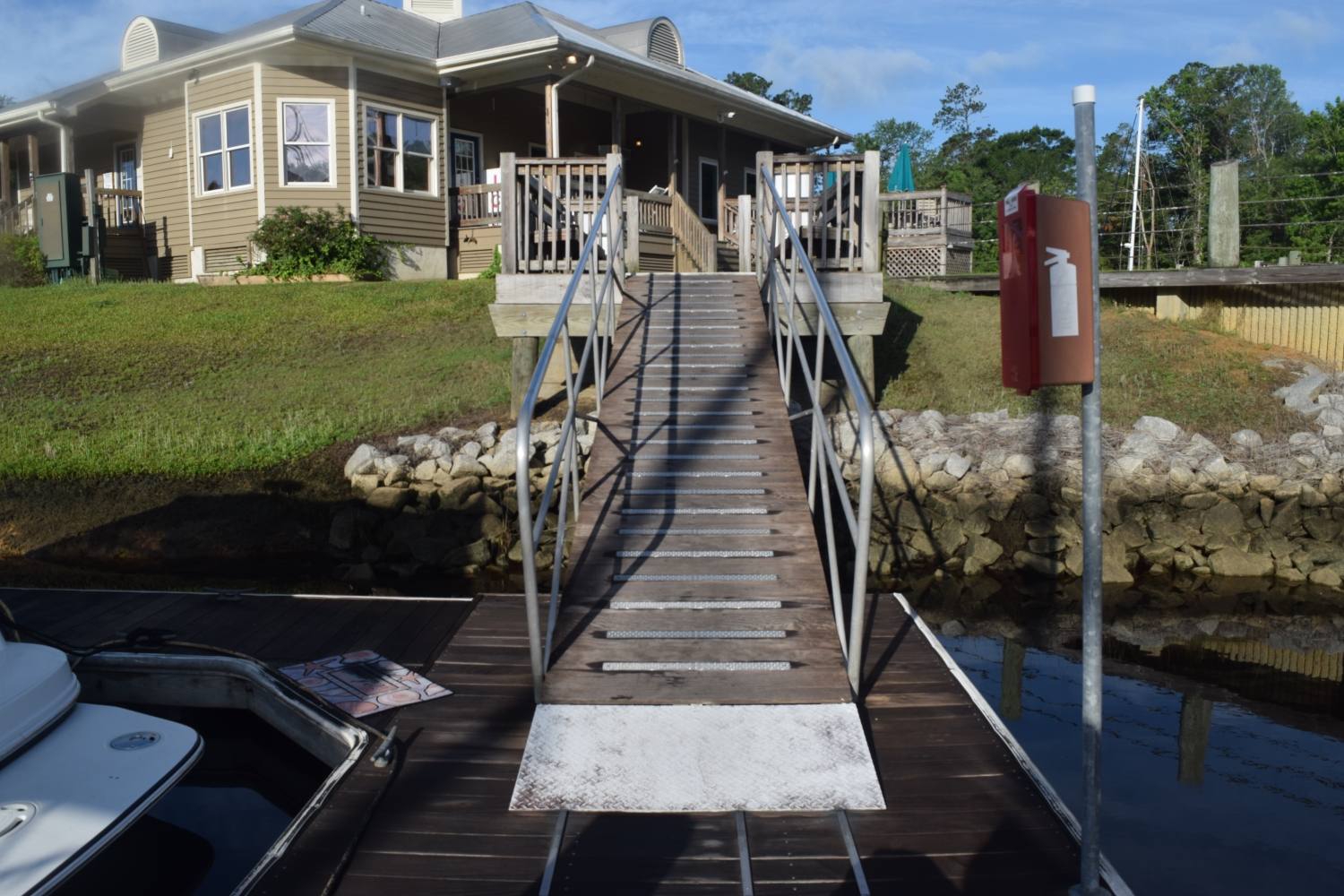
Then I dropped to my knees, brought the camera down to Honey’s eye level, and snapped this picture.
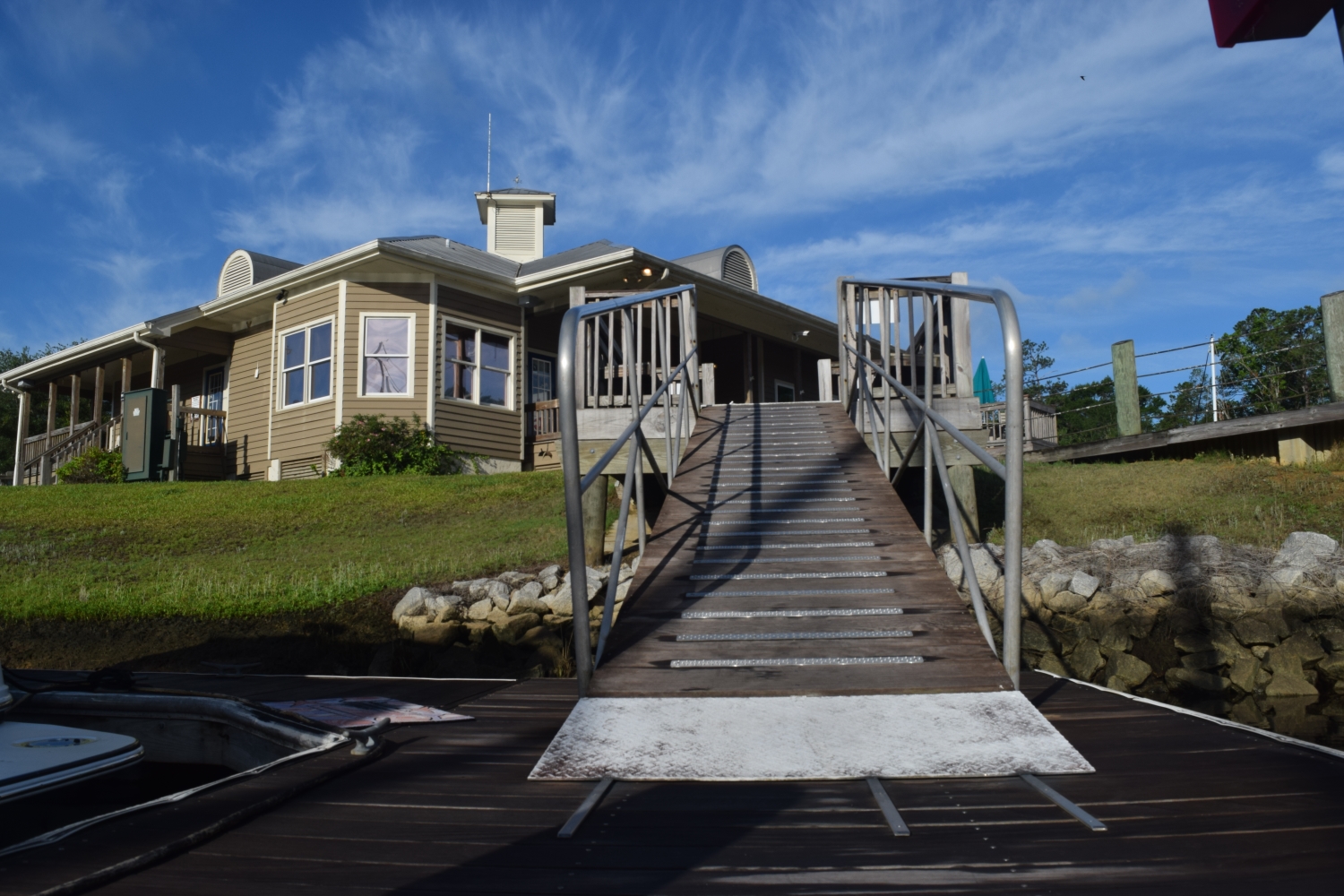
The apparent change in height between the two perspectives is, perhaps, not huge. At least, not to me. But it makes all the difference to her.
So I chose a gentler way forward. With my hand on her rump, I spoke quietly and encouragingly to her while applying a gently insistent pressure on her. “You got this. Yeah, you do!” After some resistance, she made a dash over the diamond plate until she found her paws on the wood treads just beyond. And after a few more rushed, uncertain steps, she suddenly found her confidence and proceeded to the top as if she never had a worry in the world.
What have I learned? Not enough, apparently. Because when Pam goes to take Honey up that incline, Honey will hit the aluminum bottom plate and breeze over it, and up she will go—and it doesn’t matter how low the tide or how steep the ramp.
Pam, of course, has worked every day for the last seven years to build an unfailingly positive relationship with Honey.
And that relationship hasn’t taught Honey a thing about ramps. But it has taught her to trust Pam with everything she is and has.
Note from Pam: Well, it’s not just that. I also know that Honey gets stuck once she hesitates. So I take a few steps back with her and we go up the ramp at a quick jog. Some things are easier when you go fast.
So maybe what I need is more than a simple dockside lesson in dog motivation. Maybe what I need is a whole new perspective.
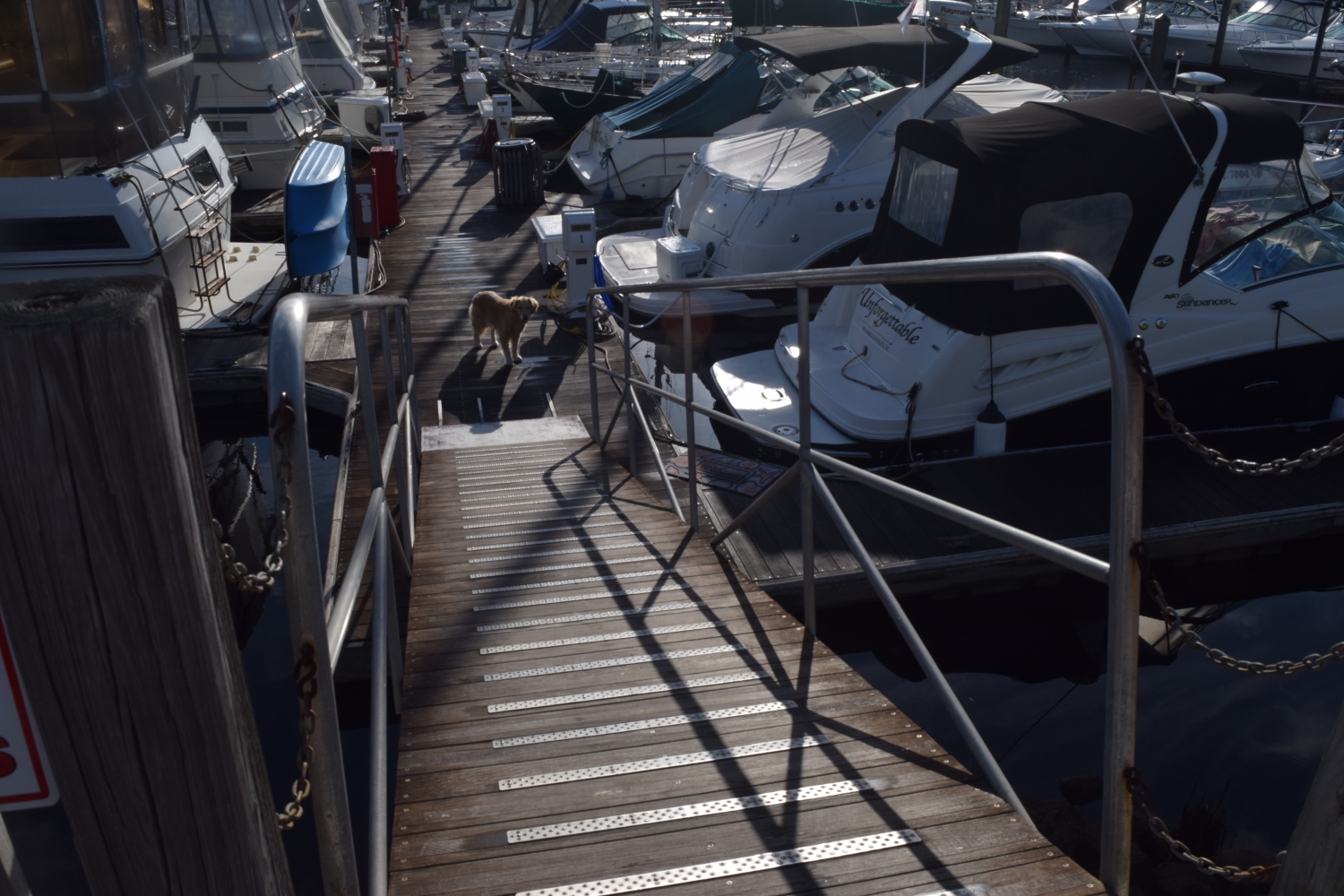
Your Turn: Was there ever a time when you put yourself in your dog’s place to understand them better?
 What Has Changed For Honey In the Dinghy?
That’s brilliant, Pamela! It makes perfect sense when there’s a point where her mind gets stuck about what is normally viewed as no big deal and to approach it from her view rather than from yours. Well done.
The Husband responds: To Pam, empathetic points of view come as no big deal; it’s part of her terrain. To her husband, though. . .
One of the things you are taught in agility classes is to view the obstacle from the dog’s perspective. Also, to walk/view the course from their vantage point so you can spot off-course possibilities you don’t notice from your human eye level. It is amazing the difference!
The Husband responds:
It has rarely occurred to me to consider problems in any situation from another’s perspective. You can imagine the chronic fallout.
Reminds me of Mom working on getting my sisters onto the agility teeter. Daunting for the dog, but with taking it slow, treats and reassurance, they got it done.
Honey went through something similar a few years ago to prep for life on a rolling boat. Pam was great with her. We shot a video of some of their work called “Adventure Dog in Training.” The post containing it is probably somewhere in Something Wagging’s back issues. Three minutes of highjinx and joy, but I have no idea how to get to it. (If your mom were to ask Pam nicely, though, she’d probably pull it out again and hook her up.)
Great post. One of my favorite books, if you get a chance to read it, is Through a Dog’s Eyes by Jennifer Arnold. Putting yourself in your dog’s place is helpful–although you probably don’t want to put yourself in Ernest’s place to understand how he’s feeling after his recent neutering.
Easy come, easy go.
Yes, often….
Once, back when I was a teenager working at a boarding kennel, I decided to see what the dogs were seeing. So I climbed into one of the pens, pulled the door shut, and got stuck! Lol, I sat there for a minute, dreading having to call for help! 🙂
Now, that’s commitment.
This is a really interesting post. I haven’t actually thought about what my little ones are seeing. I mean I try to image what it is they are thinking though.
The Husband thanks you. Your interest in what your little ones are thinking says you want to understand them. And that’s good as long as you also remember that what you imagine might be pretty different from what they’re actually thinking. In any case, putting your head near the floor to see how different everything looks to them couldn’t help but be useful in better guessing at what they think about.
In my case, I had guessed at the steepness of the ramp; and it made me slow down and be more gentle in encouraging our dog. But my wife’s note toward the end of the post made me realize that the ramp’s steepness may exacerbate issues Honey may have with its aluminum diamond-tread bottom plate.
What a good idea to take a picture from her level! Barley is used to ramps from agility class, but her little sister Rye is just getting used to different equipment at lower levels, so I’m not sure how she’d react to something like that–we usually go really slow when introducing new equipment to Rye, so that’s awesome that Pam has found what works best for Honey since every dog–and every handler–is different! I’m sure that you’ll continue figuring out what works for you and Honey together, too 🙂
Thank you for that optimistic last sentiment, Beth. After seven years, Honey has me marked down as a slow learner.
Man Mike, you made me all weepy talking about Pam’s bond with Honey.
Once when Sampson was a pup we were hiking a trail when we came upon a walking bridge that was slatted. Sampson did NOT want to attempt it, he balked and was shaking. I put myself in his paws and we turned around. We did our best to expose him to many things, but I wasn’t going to push on something that we probably would never encounter again.
Jodi, I think you’ve got it. Me, I’m just beginning to get it.
Such a great story and perspective. It’s so easy to forget how daunting everything looks from a lower point of view. (I think I’d be nervous going up a ramp like that)