
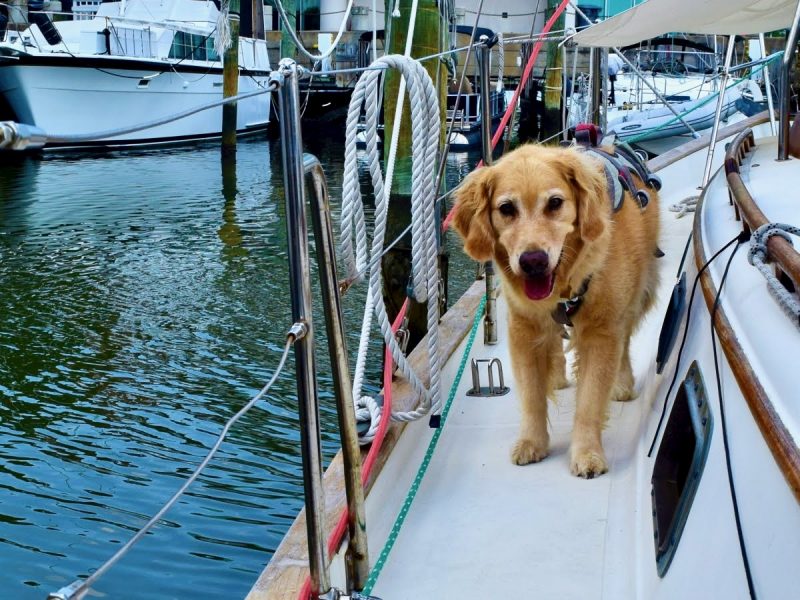
“I dream of living on a boat with my dog.”
“What?! Are you crazy?”
Okay, let’s agree you’re at least a little crazy. Obviously, having a dog (or two) will add a whole level of complexity to the life of any liveaboard or cruiser. But a dog will enrich your life on board too.
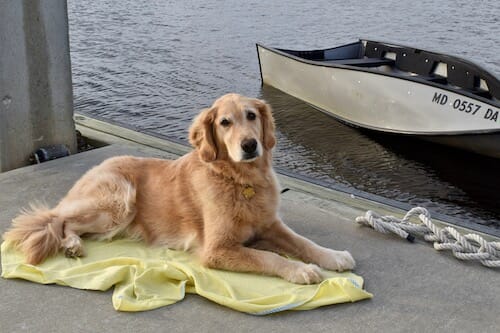
In fact, your dog may lead you to adventures you would never have had without them. And if you take time to plan ahead, I bet you’ll even love it.
In a hurry? Click below on the topic you want to explore about living on a boat with a dog.
Click here to keep reading the whole piece.
Our Tale of Living on a Boat with Our Dog
All About The Best Boat For Your Dog
All About Living On A Boat With Your Dog
- Setting routines
- Getting your dog on and off the boat
- Feeding your boat dog
- Exercising your dog on a boat
- Pottying on the boat
- Sleeping on the boat
- Dealing with your boat dog’s fear
- Keeping your dog healthy onboard
- Traveling with your dog
We’re Living On A Boat With Our Dog
When we moved five years ago aboard our Pacific Seacraft 34, Meander, we knew a bit about sailing—my husband Mike, me, and Honey, our golden retriever. We had sailed small boats for a couple of seasons on an inland lake. And we had completed a week of training on one of America’s Great Lakes.
But as far as cruising goes, we were really a bunch of newbies.
Sounds like the makings of a disaster, doesn’t it?
I’m not gonna lie. We definitely had a few days in our first year of cruising that. . . well, let’s just say “disaster” is not too strong a word.
But in our desire to make living on a boat with a dog a huge success, we had a few things going for us.
For one thing, Honey trusted us. From an eight-week-old pup to boarding five years later, Honey grew in her confidence in us as we built our relationship.
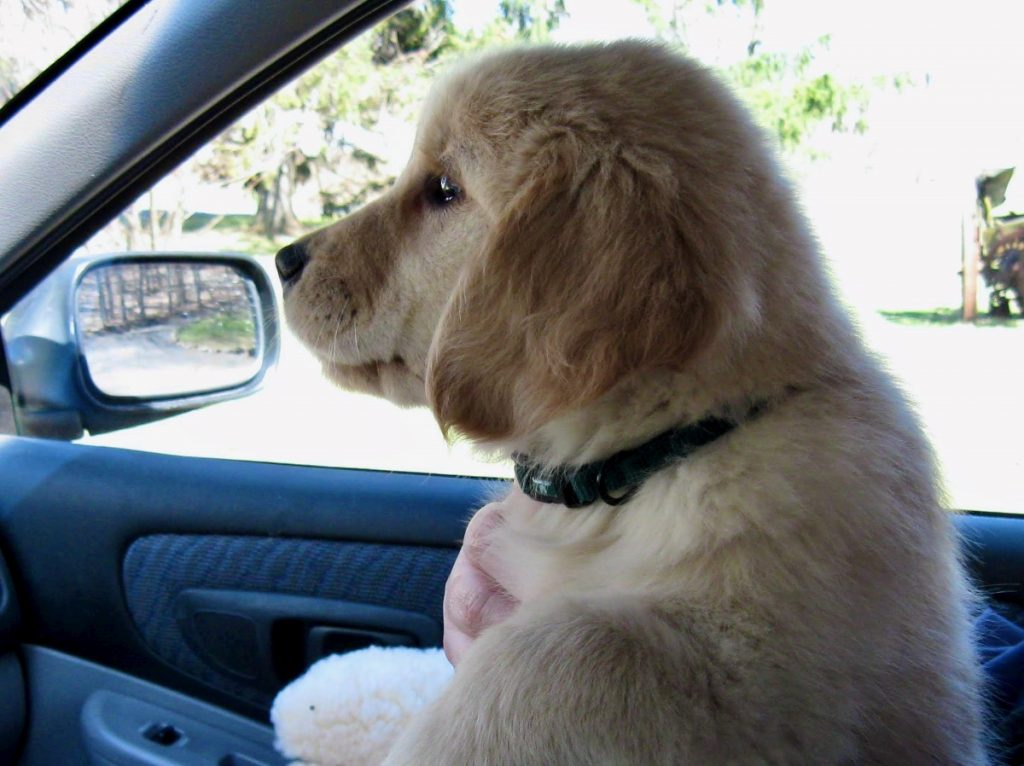
Secondly, we spent Honey’s first five years socializing and training her to help her adapt to a wide range of circumstances. In the course of our work together, I learned exactly what aspects of boat life would challenge Honey.
Knowing those things, we started to prepare Honey for life aboard long before we started shopping for boats.
It worked.
We’ve been cruising the eastern United States together for five years. Honey has thrived. She has grown in confidence.
And because Honey insists on having time to play off the boat every day, we have found some beautiful spots, often overlooked by most cruisers.
One special thrill was discovering Edisto Island State Park, a few short miles off the ICW. I don’t know what we enjoyed more—touring the nature center or using the clean, eco-friendly toilet facilities.
And thanks to a nasty infection requiring a vet’s attention, we found a great anchorage on Charleston’s Ashley River where few sailboats ever go. Yes, even a vet emergency can lead to cool discoveries.
In our travels along the Intracoastal Waterway (ICW) on the US east coast, we’ve seen many cruisers anchor for the night without ever leaving their boats. We think they’re missing out on a lot of fun. They should get a dog.
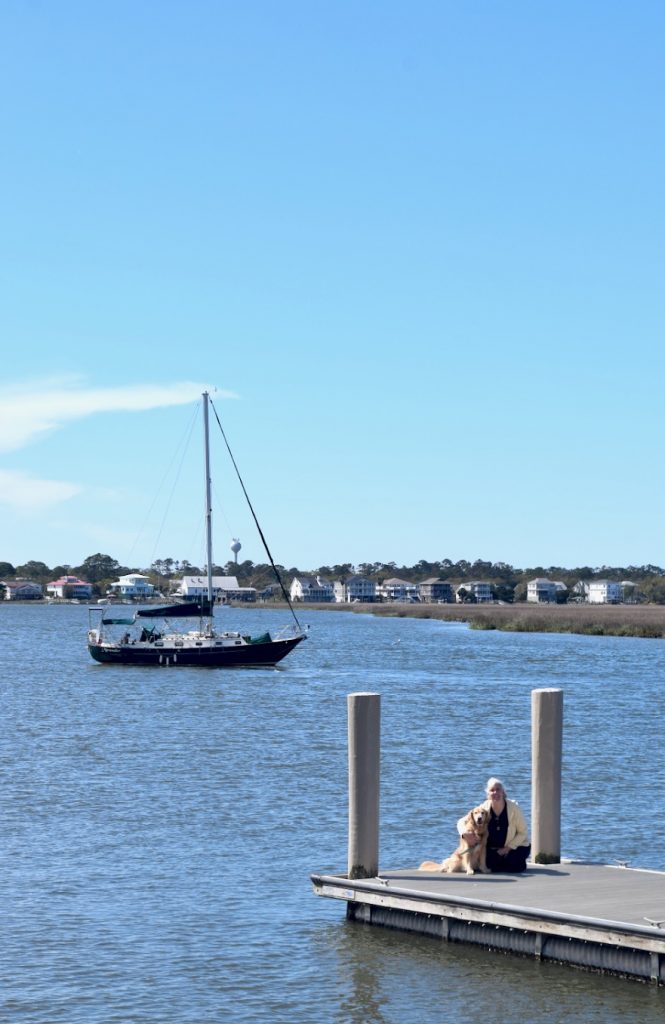
I certainly encourage you to look forward to living on a boat with your dog. To help, I’m going to share everything we considered before moving onboard with Honey. And a few things I didn’t think about at the time but that I’ve since realized are also important.
Let’s look at everything you’ll have to consider about your dog, your boat, and your life onboard.
Want to learn more about cruising the ICW? Check out
Travel Through 2018 with Meander – includes some of our favorite ICW anchorages with GPS coordinates.
The Boat Dog
Do you already love a dog? Wonder if he or she will make a good boat dog? What goes into deciding if your dog is suited to life on a boat?
Temperament
What is your dog like?
If you closely observe your dog living in your dirt house, you can accurately predict how they’ll behave on a boat. Paying attention to your dog’s temperament—what in humans we call “personality”–will help you prepare for their needs and create a plan for bringing them onboard.
For example, does your dog bark whenever someone comes up your driveway? Sounds like you have yourself a canine security system. If you plan to cruise in areas where theft is common, your dog will be a good early warning system. But if you like to stay in marinas, you’ll have to keep a lid on the barking so your fellow boaters don’t hate you.
Does your dog have poor impulse control—y’know, like a teenager? Then consider how you’ll keep them on the boat when dolphins swim by or a stranger walks down the dock with a pizza.
Does your dog quiver when a balloon pops or the ground shifts under her feet? Then you’ll want to build their confidence in new situations long before they have to endure rolling seas, or even walk up a ramp to board the boat.
Most important is knowing how your dog shows stress so you can head off problems before they happen.
A quiet dog might be relaxed. Or they may have shut down due to fear. Only you’ll know. Because you know your dog.

But temperament is not the only aspect of your dog to consider before moving onto a boat with them.
Links below may be affiliate links. As an Amazon Associate, I earn from qualifying purchases.
Want to learn more about the temperament of your dog and how it affects living on a boat? Check out:
How to Keep Your Crazy Dog From Jumping Off the Boat – tips for training and management ideas to keep your dog onboard.
Train Your Dog For Boat Life (Before You Buy A Boat) – how to start prepping your dog for the sounds and feel of cruising before you even buy a boat.
Build Your Dog’s Confidence—How To Go From Mutt To Super Hero – grow your dog’s confidence so they are ready for boat life.
Want a Happy Boat Dog? Know These Surprising Signs of Stress – do you know these 13 ways dogs show stress?
Physical characteristics
What does your dog look like? And how will their breed or breed mix characteristics determine their health?
Size
Most prospective cruisers think about one distinctive physical characteristic first before they move onto a boat with a dog—size.
Many people sail with small dogs that I’d be reluctant to have on a boat. But they’re small. So that’s all that matters, right?
Yes, it’s certainly easier to get a small dog on and off the boat. Many people don’t even train their small dogs because they always have the option of picking them up to keep them out of trouble.
And there’s also the idea that small dogs might be easier to train to potty on a boat.
But little dogs face one great risk–and it arises when your home moves. If you lurch in a rough seaway, will you injure your tiny dog?
One of the worst injuries I’ve ever heard of came when a trawler owner I met fell on his Yorkie after stumbling on the boat underway. They had to rush to get their dog to a vet emergency room.
It’s not an insurmountable problem. But if you love a small dog, you will want to give extra thought about keeping them out from underfoot when the boat starts rolling. Perhaps you’ll want to keep a folding crate (Amazon) on board, tether them to their bed, or teach them a strong “place” cue.
Accidentally injuring a sturdy medium or large dog is less likely.
But, of course, you’ll find it more challenging to get a heavier dog on and off the boat. And up and down the companionway.
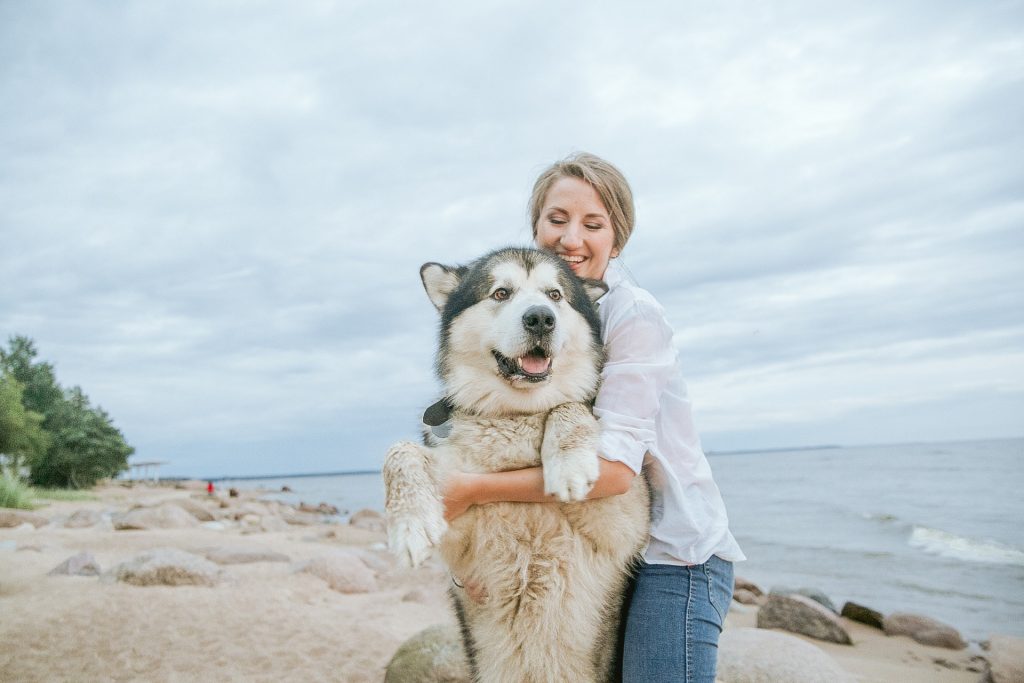
We’ve trained Honey in a unique way to get her in and out of the cabin.
- Tell Honey “Up” so she jumps up on the settee.
- Pick her up in my arms.
- Move her to the companionway and put her paws on the top step.
- Tell Honey “Paws Up” to jump and put her top paws on the bridge deck.
- Push her rear paws up onto the top step.
- Tell Honey “Cockpit” to get her to jump into the cockpit.
It works for us. But if she weighed 30 pounds more, I’d struggle to manage.

So before you move onto a boat with your medium or large dog, think about how you’ll help them get around. At the very least, start lifting weights.
Want to learn more about keeping boat dogs of all sizes safe and comfortable onboard? Check out
What’s With Little Dogs Who Pee In The House – speculations on why it may be easier to train little dogs to pee on board a boat.
The Place Command – advice from a world traveler on this crucial command to teach your dog.
5 Commands Every Traveling Dog Should Know – instructions for teaching your dog these 5 crucial cues.
Folding dog crate (Amazon) – a soft, folding crate can come in handy on a boat. Especially if your dog likes to den.
Heat tolerance
What’s cuter than a smooshy-faced bulldog? They’re adorable. Until they’re hyperventilating in the heat because they can’t cool themselves off enough in the tropics.
What if you have a husky? Should you plan to explore the Caribbean or the Northwest Passage? Don’t ask the pup. I can tell you which he’d pick.
Cooling mats (Amazon), wet bandanas (Amazon), and shade covers (Amazon) can help most dogs (and their people) stay cooler in the tropics.
But if your chihuahua gets chilled after swimming or on cool, breezy nights, he’ll need a coat–even in the Caribbean.
And don’t forget that the weather nearly anywhere can get weird. We broke ice traveling through South Carolina back in January of 2018.
So you gotta be prepared to keep your pup comfy in all kinds of weather.
Want to learn more about keeping your dog comfortable in any temperature? Check out
Pressure-activated cooling mat (Amazon) – no water or freezer needed. Pressure causes the mat to cool.
Dog-cooling bandana (Amazon) – wet the bandana and pop it in the fridge to keep your dog cool.
Shade covers (Amazon) – keep the boat cooler by shading your cockpit or deck.
Cooling vest (Kurgo) – an evaporative cooling vest for dogs.
Loft dog jacket (Kurgo) – a comfy but lightweight jacket to keep your dog warm on nippy nights or cold sailing days.
The Most Surprising Ways To Keep Your Dog Cool On The Boat – things we do to keep Honey cool on Meander.
Swimming ability
While many people associate dogs on boats with swimming, not all cruising dogs are good swimmers.
Do you know if your dog can swim?

If you’re unsure, take them to a calm beach where they can wade in or a pool with steps. Encourage them to swim while holding them for support. Or even better, put them in a life jacket (Kurgo).
Some dogs struggle to keep their heads above water. And a good life jacket with flotation under the chin will prevent your dog from getting a snoot full.
If you discover your dog just can’t or won’t swim, you’ll want to be sure they always wear a life jacket underway. And perhaps even when they’re just walking on the dock.
And even strong swimmers should only go in the water when it’s safe to do so.
A swift current can sweep any dog away quickly after an accidental fall from a dock. You want to be sure your dog can stay afloat until you can rescue them.
Ultimately, the first and last goal of everyone who lives on a boat with a dog should be to keep their pup safe.
To do that, you need to
- keep them on board
- make sure they stay afloat if they do go overboard
- have a way to recover them from the water.
Even if you have a water-crazy Lab who could out-swim a dolphin, you’re better off keeping her from going overboard in the first place. There’s a reason sailors practice crew overboard drills. And it’s far harder to rescue a frightened dog than a willing crew member in a practice exercise.
I feel very lucky that Honey never got the memo that golden retrievers love the water. While she can swim, she doesn’t care to. So we don’t usually have to worry about how to keep her from jumping off the boat.
If your dog is more impulsive than Honey, use tethers (Amazon), boat netting (Amazon), as well as a life jackets (Kurgo) to keep your pup on board (hopefully) and safe.
If your dog is a crazy swimmer, you might also want to investigate a waterproof, GPS tracker to help you track them off the boat.
But there’s one other physical characteristic of your boat dog you have to think about. And it has the potential to drive you absolutely crazy.
Want to learn more about keeping your dog safe from drowning? Check out
Kong elastic tether (Amazon) – a sturdy tether with some spring in it.
Boat lifeline netting (Amazon) – enclose your lifelines in netting to keep your dog from slipping through.
Kurgo Surf N Turf life jacket (Kurgo) – Honey’s life jacket. It can also be used as a rain jacket if you remove the floatation.
Ruffwear Float Coat life jacket (Amazon) – popular with many cruisers. It has good floatation under the chin.
5 Tips To Teach Your Dog To Swim – how to get started teaching your dog to swim.
How to Keep Your Crazy Dog From Jumping Off The Boat – tips for teaching impulse control and using management tools to keep your dog on board no matter what.
Shedding
Be prepared to manage dog hair on board. And no, adopting a no-shedding breed does not mean that life is easy.
If your dog sheds, you’ll need to brush them frequently and vacuum even more often. If your dog doesn’t shed, you’ll need to clip them. And if your dog is hairless, don’t forget the sunscreen.
To keep dog hair from taking over the boat, brush your shedding dog every time you leave the boat. We keep Honey’s Furminator (Amazon) in our dinghy/dog bag so we have it when we arrive on a deserted beach.
I’m not a good enough housekeeper to vacuum the boat every day. But dog-loving neatniks who do swear it really helps. If you have a wood sole and limited electricity, you can do just as well with a good dry mop (Amazon).
Don’t forget to take the dog fur off your settee. It’s not hard. And it keeps you from sending a little bit of your pup home with that neat couple you met in the laundry room.
If your dog doesn’t shed, get ready to develop your grooming skills. If you don’t groom your non-shedding pup, their hair will mat and cause them pain.
Want to learn more about keeping dog hair at bay? Check out
DIY Dog Grooming – advice from a cruiser on how she grooms her boat dog with clippers.
Emmy’s Best Dog Sun Skin Protector (Amazon) – protection from the sun for noses and other vulnerable areas.
Furminator (Amazon) – the best tool for getting rid of shedding undercoat I’ve ever found.
Slicker brush (Amazon) – perfect for clearing out mats before they become too bad.
Dyson handheld vacuum (Amazon) – highly recommended by cruisers with pets.
Microfiber wet-dry mop (Amazon) – just like the disposable duster but you can wash the pads and reuse them.
Pumice fur remover (Amazon) – an excellent tool for getting dog fur off napped upholstery. We also rely on it when we borrow a rental car.
Pet hair remover (Amazon) – they’ve been around for a long time. There’s a good reason–they work great.
Pet clipper kit (Amazon) – all the pieces you need to groom your non-shedding dog.
Age
If you already have a dog, you’ll find there are advantages to every age.
It’s much easier to train a puppy to “go” onboard than an older dog. But you’ll also have the challenges of taking them to their potty spot many times during the day.
Believe me, if you think a bilge smells nasty, just imagine adding puppy pee to it.
Middle-aged dogs are juuuuuuuussssst right. Most of their training is out of the way. And they are fit and spry enough to handle the physical challenges of living on a boat.
And finally, there’s something really special about the golden oldies. They usually mellow over time. But arthritis and poor eyesight can take their toll.
You’ll want to make sure you’ve trained your dog to understand hand signals in case they lose their hearing. And don’t wait until your dog is unable to jump in and out of the dinghy until you find an alternative solution.
You may even need to modify your boat ramp so cataracts don’t cause your elder to walk off the edge.
Any dog of any age can be a great boat dog. Of course, if you don’t already love a dog, you can consider all these pros and cons when adopting your new pup.
Adopting a new dog
While some dogs are bred especially for boat life (like schipperkes) or to love water (like Labrador retrievers), any dog can be a good boat dog. You just need to provide for whatever needs your dog has.
Buying a dog from a breeder is a bad bet. Unless you choose a thoughtful hobby breeder. One who will do health tests for their dogs and who provides socialization from birth. And most of all, who only breeds limited litters.
Adopting a dog from a rescue may save a life. But it can be challenging to meet the adoption guidelines for some organizations. For example, how do you explain your living situation on a boat to a rescue that requires all adopters to have a fenced yard?
Perhaps the best option is to adopt a dog from a foster home. Someone who knows how energetic a dog is.
A foster “parent” will know how an adoptable dog responds to thunder. Or strangers.
So if you don’t yet have a dog, think about all the considerations above. Be aware that any dog will need time to adjust to a new life. The behavior you see in the first days or even weeks of adopting a pup may change or disappear entirely.
And whatever dog you fall in love with, make a plan to help them love the boat as much as you do.
Want to learn more about adopting your perfect boat dog? Check out
And Now For Something Completely Serious – Selling Puppies on eBay – tips for what to look for when seeking a responsible dog breeder.
Dog Temperament Testing – tips on evaluating a dog’s temperament.
13 Helpful Questions To Ask Before You Foster a Dog in Need – for a great list of questions to ask about a prospective adoptable dog.
Learn about choosing and updating your boat to make it more comfortable for your boat dog. Go onto page 2 to keep reading.
The Boat
Yacht designers create boats built for speed. For stability. For beauty.
But none of the biggies—Bill Crealock, Ted Irwin, Robert Perry—none of them ever designed boats specially built for dogs.
What does that mean for you?
It means you can’t google “best boat for dogs” and get a good answer. (Hmmm, maybe I should start writing one.)

But if you think about your dog while boat shopping, you will find a vessel with features that will make living onboard with your dog much easier.
What boat features must you evaluate for your dog?
Stability
Everyone is more comfortable in a sea-kindly boat. But sea-kindliness benefits your dog even more than it does you. After all, you can’t explain to your dog that the keel will keep your boat upright under most conditions.
Or you can. But it won’t make him feel better when you’re racing along with the rails in the water.
We bought a boat that is far sturdier than our cruising grounds require. And there are many things about a Pacific Seacraft that are far from dog-friendly. But its weight and stability make it a very comfortable ride for us and for Honey.
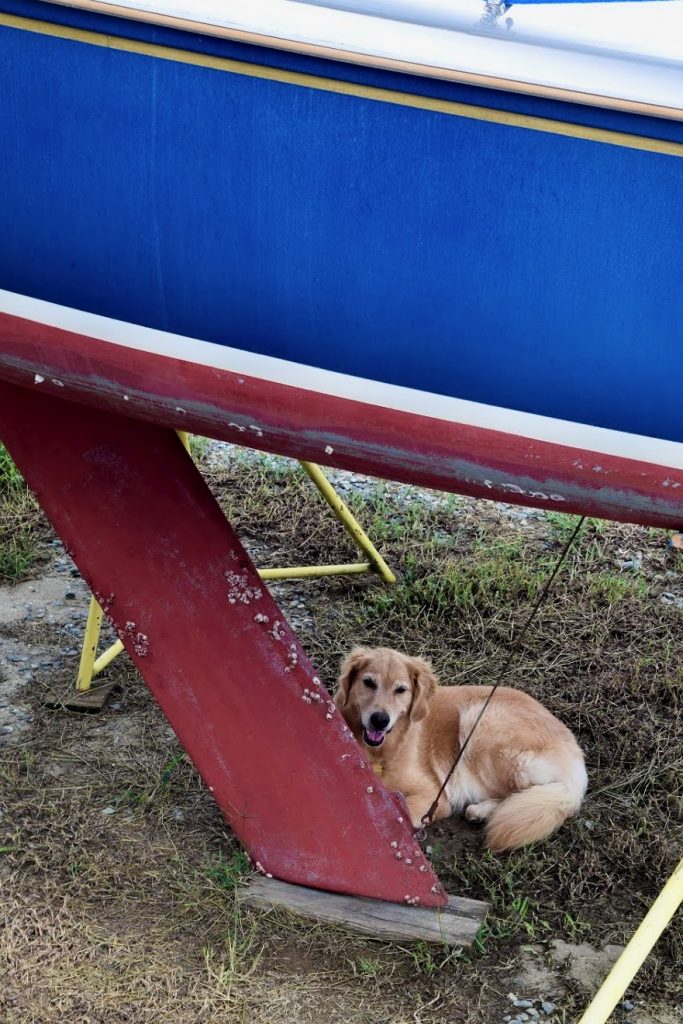
Years ago I read about a couple who set off from the San Francisco Bay with their two West Highland white terriers on a monohull. By the time they passed under the Golden Gate Bridge, the dogs were panicked by the heeling.
The family returned to the dock, sold the boat, and bought a catamaran before setting out again. Makes you wonder if they should have taken the dogs on the boat before setting off cruising, doesn’t it?
But the lesson is valuable for anyone. Buy a boat with enough stability to keep everyone on board happy.
Another important factor to consider about your boat, especially if you plan to cruise with a large dog, is the size of your vessel.
Boat Size
I’m not a member of the “buy the biggest boat you can afford” club. Costs go up exponentially for every foot you add to your vessel. And you do, after all, still need to pay for kibble and squeakies.
But you need to make sure your boat fits your dog. Or vice versa.
The layout can make a big difference in helping a small boat live large.
Our Pacific Seacraft 34 fits one 50-pound golden retriever very well. But if I were cruising with an even larger dog, I might hold out for the model whose saloon table swings down from the wall instead of the one permanently mounted on the centerline, like ours.
Every boat feature you consider will have tradeoffs. And you need to consider them carefully, for yourself and for your dog.
When you’re considering the size of your vessel, don’t go crazy thinking about the length overall. Instead, think about size in terms of how your dog will live on the boat. And how the various measurements will affect everyone’s life on board.
A beamy boat may be easier for your dog to roam around but harder for you to find safe handholds in an active seaway. And some beamy boats live beautifully at the dock but bob in a very uncomfortable motion underway.
If your dog shares your bed, is the main berth large enough? Or is there some part of the boat where your dog can curl up on her own without becoming a tripping hazard?
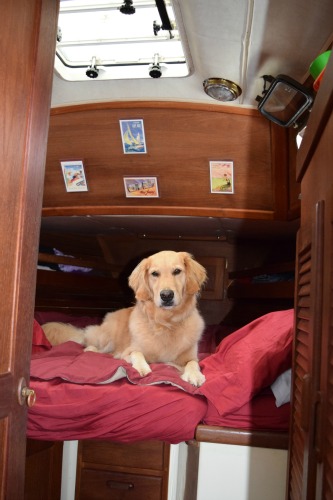
If you choose a sea-kindly boat with less beam, can your dog turn around in the center of the saloon? Or will you need to teach them to back up to get unstuck?
Is the area around the companionway roomy enough that you can place a ramp if your dog can’t climb a ladder or steep stairs?
And while you’re thinking about dimensions, don’t forget to consider the freeboard.
Your young, fit retriever might find it easy to jump 5 feet from the deck into a dinghy. But what happens when they get older? Are you prepared to help a 70-pound pup into your boat “car” every day?
Bluewaterboats.org – nothing about these reviews of bluewater vessels mentions how they’d work for dogs. But it’s a good resource for anyone shopping for a sturdy bluewater boat. And it’s a good education even if you’re shopping for a lighter coastal cruiser.
Boarding
While admiring new boats, don’t forget to think about how you’ll get on and off. And then ask yourself if you could do it without opposable thumbs.
I gotta admit. When I see a boat with an open transom, swim platform, or sugar scoop, I think of how easy it must make getting a dog in and out of a dinghy. But some conditions are challenging for any boat.

For example, if you’re tied up to a fixed dock, you’ll have to pay attention to the tide. Even on the Chesapeake Bay, a particularly high (or low) tide will make boarding especially difficult—for any boat.
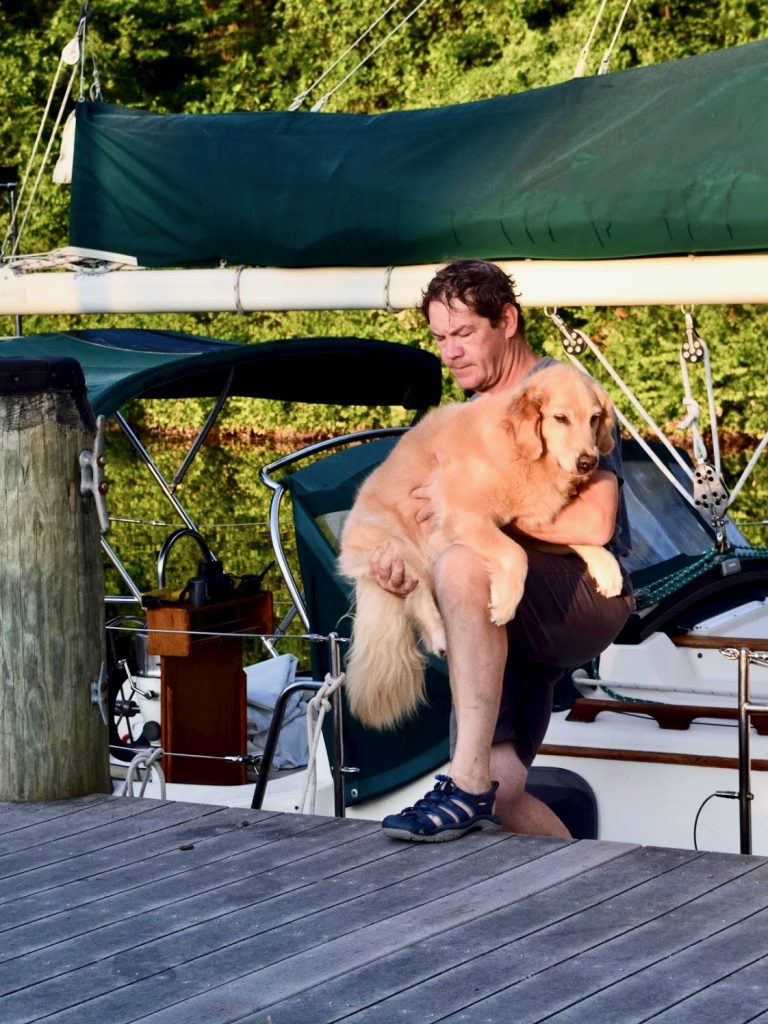
When the high tide at a fixed dock makes Honey’s ramp too steep for her, we find it easier to lift her onto the boat. But she’s only 50 pounds. If your dog is bigger, that may not be an option for you.
During an extremely low tide, we reduce our portable ramp’s steepness by placing it over the aisle instead of in it, landing the boat end on our cabin top. But the narrow aisle provides too little runout room for Honey to jump down directly from the cabin top. So after she boards, she has to go forward to the bow, jump down to the open deck there, and then come back down the aisle to the cockpit.
It sounds complicated, but it works for us.
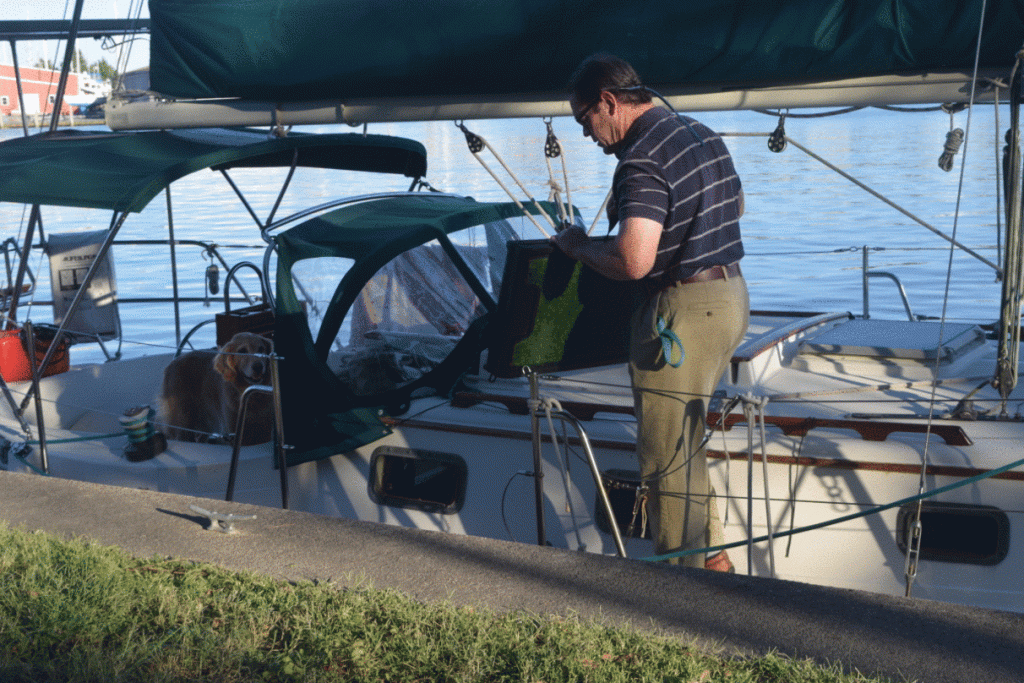
When you’re tied up alongside a dock, think about how the lifelines will affect your dog. If your pup is small, they will have no trouble scrambling underneath. But you’ll need to make some allowances for medium or large dogs.
A gate with pelican clips works great. And side boarding works well with a range of ramps and stairs—if you have room to store them.
If you’ve fallen in love with a boat that wasn’t designed for dogs (like we did), you can make it work. But you will have to invest in gear or alterations to the boat.
Want to learn more about getting your dog on and off the boat? Check out
How to Take Your Dog for a Walk – describing the method we use to get Honey off the boat at a marina.
Boat Dog Accessories – tells about the two ramps we’ve used onboard Meander.
Boarding Steps for a Big Dog – one cruiser’s method of getting their dog off their boat.
Outfitting a boat for dogs
Boaters are incredibly resourceful people. Poll enough cruisers with dogs and you’ll find dozens of amazing ways to outfit a boat to work better for a dog.
Keep your dog from going overboard
Probably the most common boat alteration cruisers make for their dog is adding lifeline netting (Amazon) to keep pups from disappearing under the lifelines. We’re unusual in not having netting on Meander. But we keep Honey in the cockpit while underway.
Running jack lines (Amazon) and a tether (Amazon) for dogs is another solution. Of course, it’s better to keep your dog out of the water to begin with than to have them towed after the boat when they fall in.
Lifelines are designed to protect people, not dogs. So think about whether yours will keep your dog safely on board.
Help your dog get on and off the boat
We altered our lifelines in a way that has really benefited us when getting Honey on and off the boat.
When it was time to replace our lifelines, we opted for Suncor fittings instead of traditional swaged fittings.
You install Suncor fittings with basic wrenches. No special swaging tools are needed. That means that not only are they easy to assemble, they’re also easy to disassemble.
When we land at marinas with stubby finger piers that didn’t reach our gates, we turned the boat bow in. After disassembling the lifeline fittings at the bow pulpit, it’s easy to take Honey on and off the boat using our ramp (Amazon).
Want to learn more about boat alterations to help your dog? Check out
Boat lifeline netting (Amazon) – to keep your dog from slipping under lifelines.
Jack lines (Amazon) – tether your dog to jack lines so they can safely roam the deck.
Kong elastic tether (Amazon) – springy tether to attach to jack lines or another secure point.
Suncor lifeline kits – assemble and disassemble your lifelines with standard tools.
Ramp (Amazon) – our current ramp for helping Honey get on and off the boat at a dock.
Help your dog up and down the companionway
You can also alter your companionway stairs or ladder to help your dog feel more secure climbing.
If you add a backing to the ladder so your pup’s feet don’t go through, they will feel less precarious while they’re training.
Or one clever cruiser added two u-bolts to the bottom of each tread. He then put steel rods through the bolts to support plywood extension boards. By lengthening the ladder treads in this way, he made the ladder less steep for his dog to climb.
And, of course, if you have the room for it, you can always run a ramp to the top step to help your dog get out on his own.
Also, look around at your boat to see if you can make your dog’s trip up the stairs easier by breaking it up. Some dogs find it easier to jump up onto a nearby berth or settee before climbing the last few treads on a steep ladder.
Give your dog a safe place to rest on the boat
Don’t forget to provide a comfortable “den” for your dog. It will go a long way toward keeping them safe and comfortable. The space under the navigation station so many of us no longer use is a perfect spot to make a sleeping area for a small or medium dog.
Our dog likes to “den” under the saloon table. I’ve taught her to go there when I’m cooking.
It’s just one little trick that keeps both of us safe. And makes living on a boat with a dog just a little bit easier.

If you live on a monohull sailboat, you’ll want to make sure your dog can be comfortable on both tacks—especially in the cockpit. The last thing you need when you’re fighting rough seas is to have your dog scrambling back and forth trying to get comfortable.
We’ve joked about creating a gimbaled dog bed for Honey. It would be easy to create a safe “swing” for a small dog that leaves them level no matter how you’re sailing. Although I’ve never known anyone to do it for a dog bed, I have heard of cruisers who have hung a baby carrier from their bimini frame.
Once you’ve considered everything that goes into choosing (or preparing) your dog and choosing (or preparing) your boat, think about your daily life.
So what’s it really like living on a boat with a dog? Go onto page 3 to keep reading.
Living On A Boat With A Dog
You’ve thought about your dog and how their temperament and physical characteristics will help or hinder them on a boat.
And you’ve considered how the vessel itself can make things easy or difficult for living on a boat with your dog.
So let’s assume you’re set. You got the dog. You got the boat. What goes into actually living on the boat with your pup?
Setting routines
Dogs are always more secure when they can rely on a regular routine. Luckily, your dog’s favorite routine is being with you.
But they also feel more secure being fed at the same time, going to bed at the same time, and having a regular exercise routine.
Our travels sometimes have us leaving early in the morning to time tides or bridge openings. But even if weighing anchor can happen at different times, Honey knows she can count on getting all the exercise she needs before we leave.

Morning playtime is part of her routine.
And no matter what else is happening, we’re never late in feeding Honey.
The more you can establish regular routines on your boat, the easier it will be for your dog to make the transition to life aboard.
Getting your dog on and off your boat
If you want to live on a boat with a dog, you’ve gotta figure out how to get them on the boat—from a dinghy at a mooring ball or anchor, from a fixed dock, from a floating dock, and from a Med-mooring.
Once they’re on, you’ll eventually have to take them off the boat again—to a dinghy, to a fixed dock, to a floating dock, and to a Med-mooring.
If your dog loves swimming, you’ll also need a plan for getting them back on board from the water.
And of course, you’ll want to figure out a plan for every contingency. Because I guarantee you that there’s no better way to assure the marina you’re interested in will have no slips left than arriving there without a plan to get your dog off the boat at the mooring ball or anchorage just beyond it.
Oh, and let’s not forget taking your dog off a boat up on stands in a boatyard. That is its own adventure.
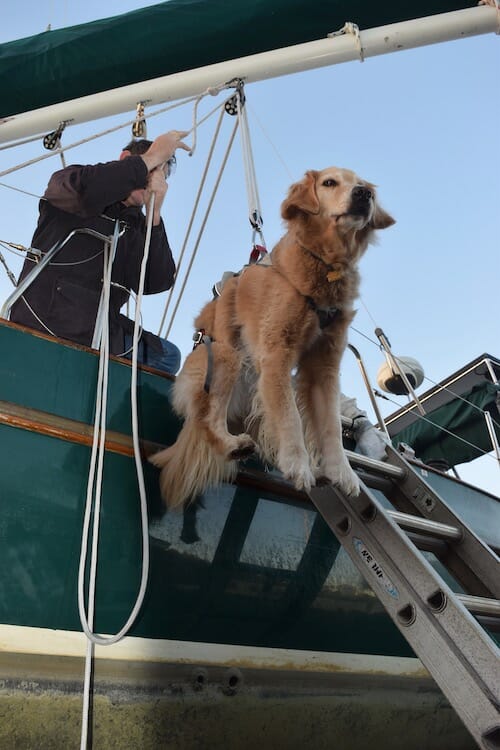
We’ve relied on a variety of tools to get Honey on and off our boat. They include a mix of
- training
- ramps
- safe carrying
- boatyard stairs
- a mountaineering harness (Amazon)
- a 3-1 Lifesling block & tackle
Some other folks rely on a specialized dog carrier (Kurgo) (for small to medium pups) or a support sling (Amazon) to help older dogs jump more safely.
Each method of taking your dog off the boat has its own challenges. You need room to store your equipment. It has to work for your dog. And you need to teach your dog how to use it safely.
Our biggest challenge was teaching Honey how to walk on a ramp. She hated it so much she even passed up the liver treats I spilled all over it. Eventually, we used agility equipment in the backyard to build her confidence and help her feel comfortable on a ramp (click for a short video to see Honey in action).
Your challenge might be a fun-loving pup so excited to go for a walk that he goes flying off the boat when you’re not ready.
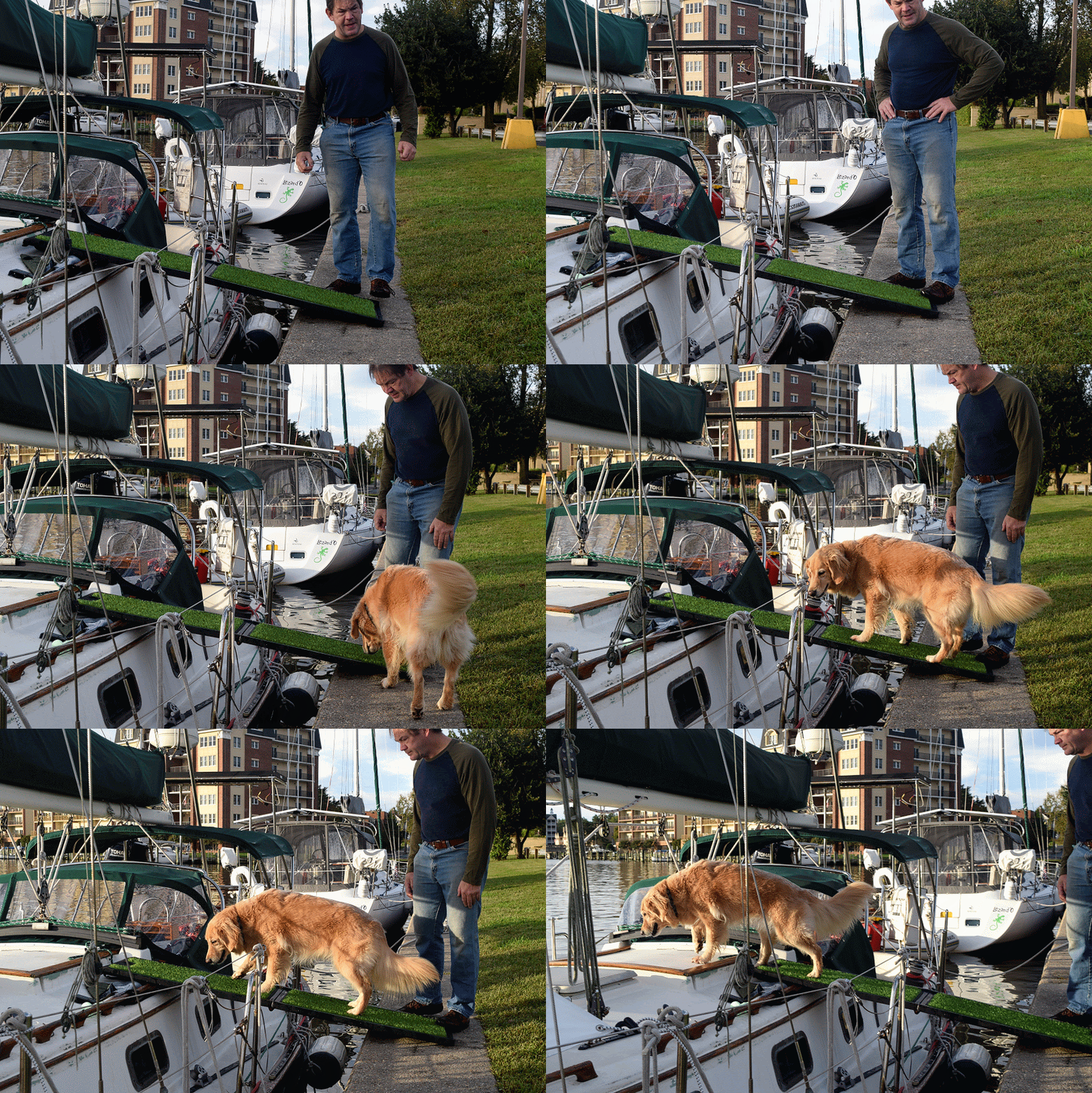
Getting your dog safely on and off the boat is so crucial that it’s something you’ll want to start working on long before you move onboard.
Of course, your dog’s biggest priority will probably be eating.
Want to learn more about getting your dog on and off the boat? Check out
Taking the Dog for a Walk at Anchor – for the method we use to lower Honey into the dinghy using a block and tackle.
Adventure Dog in Training (video) – showing how we used agility equipment to teach Honey to walk on a ramp and tolerate surfaces moving underfoot.
Boat Dog Accessories – to learn about the two different styles of ramps we’ve used on Meander.
Lifesling 3-1 Block and Tackle – what we attach to our boom to raise and lower Honey safely.
Ruffwear Double Back mountaineering harness (Amazon) – the safety harness we use to lift Honey.
Dog Carrier Backpack (Kurgo) – carry a dog as heavy at 25 pounds on your back, leaving your hands free.
Dog support sling (Amazon) – help to give dogs a little extra help up, especially if their joints are weakening. (NOTE: these slings are not meant to lift your dog; they simply allow you to give them extra support.)
Feeding your dog
Living on a boat, your three biggest feeding concerns are what you’ll feed your dog, where you’ll buy it, and how you’ll store it on board.
Yes, I know. Your dog is perfectly happy eating your hamburgers, your cookies, and your bacon.

But especially if you’re cruising in a way that keeps you far from a vet, you want to do everything to keep your dog healthy. And burgers, cookies, and bacon aren’t going to do it (for you or for your dog).
What to feed
If you’re cruising with your dog, you have several feeding options. But the challenges that come with living on a boat will make some choices more difficult than others.
Especially if your favorite dog feeding option is ordering a burger without a bun at a fast-food drive-up window.
Let’s look at some common dog food options along with their pros and cons:
- Dehydrated or freeze-dried food
- pros: high in nutrition, light in weight, easy to store
- cons: expensive, hard to find outside developed areas
- Kibble
- pros: available everywhere, inexpensive
- cons: often low in nutrition, heavy, hard to store
- Raw
- pros: high in nutrition, easy to buy proteins anywhere, dogs love it
- cons: takes education to feed properly, need access to cold storage (or the ability to catch fish every day)
- Homemade
- pros: high in nutrition, can be made as you need it based on ingredients you have
- cons: takes education to feed properly, takes time to prep
- Dog eats what you eat
- pros: you’re only prepping one meal
- cons: you may not meet all your dog’s nutrition needs without supplements, your dog will never allow you to eat a meal without them again
I’ve fed my dogs by every method except for eating what I eat (unless you count allowing her to lick out my yogurt bowl) and raw feeding.
Currently, we feed Honey kibble and supplement it with freeze-dried raw food.
There’s no reason you can’t switch between different feeding methods depending on where you are—as long as your dog doesn’t have a sensitive digestive system or allergies.
You can even use a hybrid approach, such as supplementing kibble with raw or freeze-dried food like we do.
Experiment with feeding options in your dirt house. What works for you? And for your dog?
Then ask yourself how well it will transfer to living on the boat.
Want to learn more about feeding your boat dog? Check out
Keep the Tail Wagging – for raw feeding resources.
A Novice’s Guide to Raw Feeding for Dogs (Amazon) – a primer on raw feeding.
Dr. Pitcairn’s Complete Guide to Natural Health for Dogs & Cats (Amazon) – for nutritious homemade recipes and supplements to keep your dog healthy.
Boat Dog Food – one cruiser’s story of what she decided to feed her dog on board.
Review of Honest Kitchen Dehydrated Food – Honey and I both sampled it in our video.
Honest Kitchen Human Grade Dehydrated Grain Free Dog Food (Amazon)
Sojo’s Freeze-Dried Raw Dog Food (Amazon)
How Do We Feed the Dog? – describing how we feed Honey while cruising.
Where to buy dog food
Most cruisers point out that you can buy kibble just about anywhere. But is what you find in a grocery store in Panama the best option for your dog?
While I wouldn’t recommend cheap kibble for any pup, you have to work with what you have. And supplementing kibble with fresh food you buy for yourself is a good compromise.
Larger cities in Europe will have higher quality foods. And you’ll have access to public transportation to buy them.
In the United States, most pet supply stores will carry a variety of nutritious food, including freeze-dried or frozen raw food. But they’re not often accessible to common cruising areas.
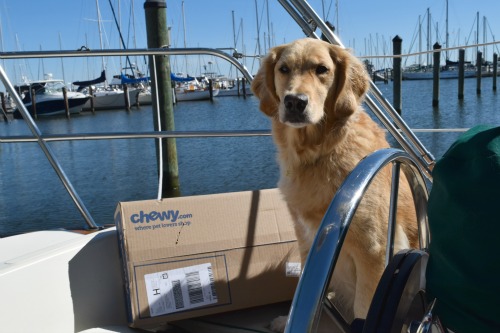
You can order food from a company like Chewy and have it delivered to a marina. In much of the eastern United States, they deliver within a day or two. So you don’t have to layover too long waiting for a delivery.
Once, in a marina laundry room, I overheard a cruiser placing an order she planned to pick up in another city. She was ordering pounds of organ meat, chicken necks, and whole quails. Maybe it was her grocery list. But once I saw her poodle, I guessed she was placing a butcher order to raw feed her dog.
The availability of proteins and vegetables for humans nearly anywhere in the world makes raw and homemade a particularly flexible choice for feeding your cruising boat dog.
The chickens delivered from the veggie boat in the Guna Yala all came with necks. I can guarantee your pup will find them tastier than most cruisers.
But after you’ve bought your dog’s food, how do you plan to store it?
Want to learn more about where to buy food for your boat dog? Check out
Chewy.com – delivers food throughout the United States. Excellent customer service.
30 Best Cheap And Safe Dog Treats From The Supermarket – when there’s no pet supply nearby, you can get good dog treats at the grocery store. Just stay out of the pet food aisle.
Storing dog food on a boat
If you buy dog food in bulk, you’ll need to keep it away from light and air. But that can be a challenge if you buy food 30 pounds or more at a time. You might not have room to store such a large bag easily.
I break Honey’s kibble down into smaller containers that are easier to store. A gallon-size zipping plastic bag holds 8 cups of food. Before storing the food. I date and label the bags and keep the original bag for details in case of a food recall.
One bag goes into an accessible pantry. I store the rest under our starboard settee.
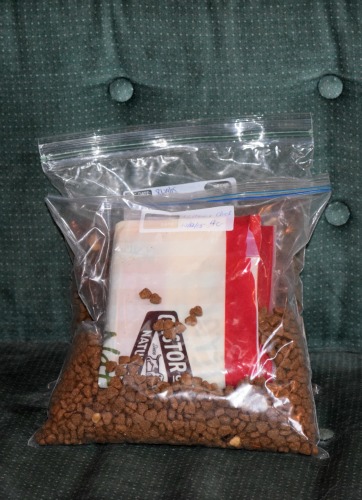
You can store freeze-dried food similarly to kibble.
But most raw and fresh food will need space in the refrigerator or freezer.
Don’t forget that you’ll need to keep bugs out of your dog’s food as well. Like any dry food you store on board, it can attract ants or weevils.
Make sure you’re not storing enough food for crossing the Pacific Ocean if you’re only cruising the Chesapeake Bay. If you’re a coastal cruiser, you’ll have plenty of chances to stock up on food regularly.
You’ll also want to know how many calories your dog burns. In other words, don’t stock up for a Great Dane when you’re cruising with a Yorkie.
Finally, don’t overfeed your pup. While making him gloriously happy, too much food will also make him sick. And if you don’t manage what your dog eats, you may find your dinghy riding low in the water. Time to exercise.
Want to know more about storing dog food on a boat? Check out
How Do We Feed The Dog? – how we feed and store Honey’s food on Meander.
Storing Dry Dog Food – storing dog food on a boat.
Dog Food Calculator – figure out how much you need to feed your dog to keep her at a healthy weight.
Exercising your dog on a boat
If your boat dog is tiny, even the smallest boat has enough room for you to wrestle and play fetch.
And you should. It’s fun. And it keeps your pup healthy.
But even larger dogs can get exercise in a small space.
Jumping on and off settees, climbing companionway ladders, and swimming are all good physical exercise on and around the boat. If your dog loves to play tug, you can adapt it for a small space.

But what’s important to realize about dogs is that they benefit as much from mental exercise as from physical exercise.
I have yet to exhaust my golden retriever by hiking or running. I’m not physically capable of going far enough, fast enough to tire her out.
But after 15 minutes of trick training or nose work games, Honey is chasing rabbits in her dreams for hours.
Simple tricks you can teach your dog include giving you a “high five” and going to bed on a mat (a really useful skill if you worry about tripping over a begging pup while cooking).
Canine nose work is a competitive dog sport based on the work of dogs who detect drugs, explosives, or who find missing persons.
But the home (or boat) version can be as simple as teaching your dog to sniff out treats. Once your dog knows what to do when you say, “Find it,” you’ll have a game that’s fun for your dog and good mental exercise as well.

One of the best ways to tucker your dog out is the most surprising.
Toss out your dog’s food bowl. Even eating can be an enriching activity for a dog—if you do it right.
Serving food in a toy has several benefits, including slowing down eating (which may prevent fatal bloat) and working your dog’s brain.

Our dog Honey’s first food toy was a soda bottle. Since she was a wee puppy, we put her kibble in a bottle and stood it on end. To eat, Honey would push the bottle over to eat the food that spilled out.
We’d continue to stand the bottle up so Honey could keep knocking it over until she finished eating.
You can buy a variety of food toys from the simple (a Kong (Amazon) which you fill with soft food) to puzzles (Amazon) that require a dog to problem-solve. Some people even use a snuffle mat (Amazon) to feed hard food while containing most of the mess.
Of course, everything that goes into your dog also has to come back out again. Bringing us to the most common question cruisers ask about living on a boat with their dog.
Want to know more about exercising your boat dog? Check out
11 Ways to Tire Out a Dog in a Small Space – they’ll have your dog napping in no time.
Nose Work Games: The Best Way to Have Fun With Your Boat Dog
How to Calm Your Dog When She’s Just Gone Crazy
Kong food toy (Amazon) – makes your dog work for his food.
Interactive food puzzles (Amazon) – works your dog’s brain by solving puzzles to eat.
Snuffle mat (Amazon) – encourages your dog’s foraging instincts.
“Going” on the boat
Posts about marine heads and puppy potty habits dominate cruising groups on social media. After all, everybody poops.
If you can train your dog to “go” on the boat you will have more options for overnight anchorages. It also makes long passages possible. But while every dog will eventually potty on board rather than explode, it’s not an easy transition for some dogs.
So how do you give your the dog the best chance of pottying successfully on the boat?
Teach your dog to potty on a boat
Most cruisers agree on the basic steps to teach your dog to potty on a boat.
How to train your dog to “go” onboard
- Start early
Don’t wait until you’re headed out on a long passage. Train before you move onto a boat.
- Train your dog to “go” on cue
As your dog sets up to pee, use the cue you want them to associate with peeing. Repeat with a different cue for pooping.
When they eliminate, praise them gently. Practice until your dog eliminates on cue. - Teach your dog to “go” on the substrate they’ll have to use on the boat.
If you’d like your boat to eliminate on a fiberglass swim platform or deck, start expecting them to pee on other surfaces that don’t drain (be aware most dogs prefer to pee on a substrate that drains).
If you want them to use a fake grass mat, start using it in your backyard. - Move all the steps onto the boat.
Do everything you do on land but on the boat.
If you’re using a fake grass mat, put it on the boat. If your dog always eliminates when they’re leashed, walk them on a leash to their new potty spot. Use your cue to encourage them to go.
If they don’t, walk them back to the cockpit and try again later.
For a step-by-step plan, check out the expert tips on How to Potty Train a Boat Dog. Author Michelle Segrest details exactly what it took for her sail dogs, Cap’n Jack and Scout, to get used to “going” onboard.
If your dog won’t potty on the boat
Be patient. Any dog can struggle with figuring out what you expect from them–especially if they’ve been carefully trained to never eliminate in your dirt house.
You may need to repeat the steps above and tweak them to work better for your dog.
Perhaps your male dog needs a vertical surface to urinate against. Or prefers to mark over the scent of another dog.
Some dogs (particularly larger ones) will strongly resist eliminating near where they sleep and eat.
And a few dogs will find even the idea of eliminating onboard highly stressful.
I’ve observed 9 reasons boat dogs might hesitate to potty onboard. And I suggest tips to help you make eliminating on board easier for your dog.
But what if you try everything and your dog still refuses to “go” on the boat?
Coping with a dog who won’t potty on a boat
More than a year before we moved onto Meander, I started preparing Honey to potty on board.
I bought the fake grass mat we hoped Honey would use as her potty on the boat. Only after snow covered it would Honey deign to use it.
The mat had her scent on it when we moved onboard. But she had no interest in continuing to use it. In fact, she waited us out 33 hours despite us giving her many chances to use her mat on the bow.
When we finally docked, not only did Honey not pee on the dock, she waited while I conducted business with the dockmaster. She only relieved herself after we walked a substantial distance past where most other boat dogs had eliminated after they got off the boat.
Only a severe urinary tract infection on a stormy night at anchor convinced Honey to “go” on board. She did it exactly twice. And never again, even while she was taking antibiotics for her infection.
Some dogs find breaking their house training very stressful. So do many dog lovers.
It’s a little-discussed fact that at least some coastal cruisers have changed their travel plans to make sure they can take their dog off the boat at least once or twice every day.
We have. And I don’t regret it even a little bit.
If your dog won’t eliminate on the boat, don’t let anyone shame you over it.
After all, you know and love your dog more than anyone else. I’m confident that you’ll make the best choices for your dog.
So we’ve covered eating and eliminating. What necessity is next? It must be sleeping.
Want to know more about training your dog to potty on the boat? Check out
How to Potty Train Your Boat Dog – tips and first-hand experience from a world cruiser.
9 Reasons Your Dog Won’t Pee On Your Boat – to see some common problems and suggested solutions.
Teach Your Dog to Potty on Cue – video on how to teach this important skill.
Sleeping on the boat
Dogs need an average of 14 hours of sleep each day. Where will they get it on your boat?
Your first clue is where they like to sleep on your dirt house.
Does your guard dog like to sleep at the front door? Do they have a favorite “den?” Or is your pup waiting for you to squeeze in beside her on your bed?
It’s very unlikely that your dog will adapt easily to a sleeping place drastically different from what they’re used to.
If they like sleeping in a crate, you’ll need to arrange a crate (or crate-like hidey-hole) on the boat. If they like sleeping with you, just try going to bed without them.
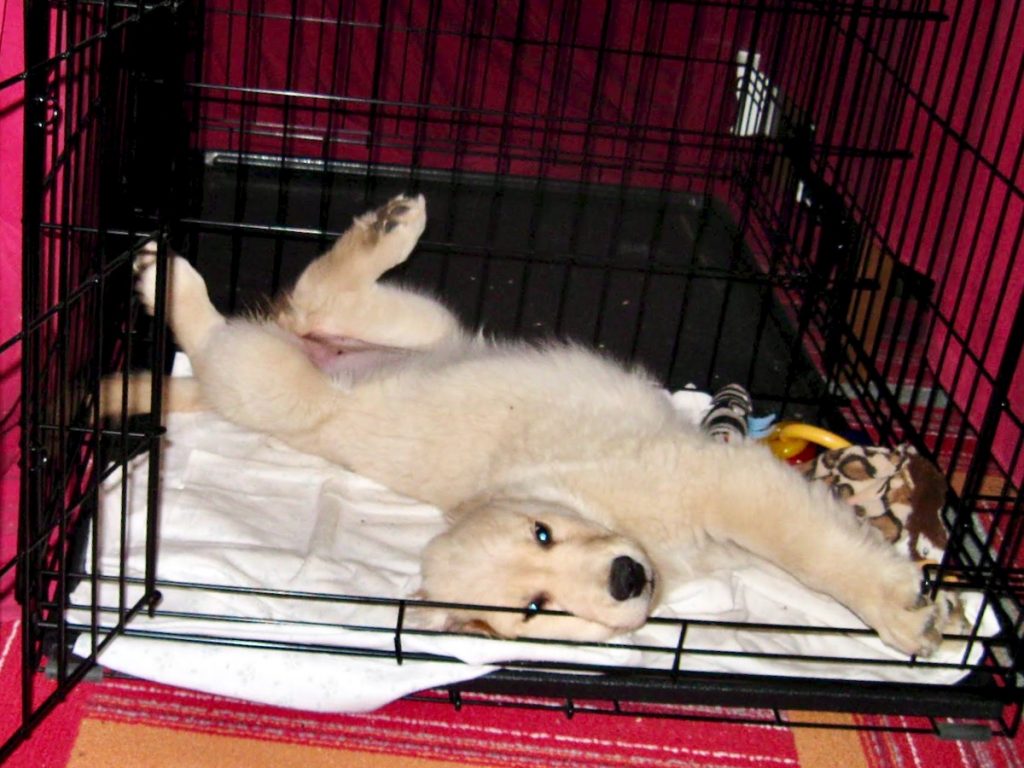
And if they’re independent and want their own space, you may have to figure out how to let them sleep on the deck without worrying about them going overboard.
For five years, Honey slept in an open crate beside our bed. When she was tired, she’d let out a little woof to let us know it was time for bed. If we didn’t follow, she’d put herself to bed.
But when we put our house on the market, we folded up her crate and stored it in the attic. (You’ll never find a big old dog crate suggested in articles on staging a house for sale.) So Honey, at 5 years old, got used to sleeping on our bed.
And that was that.
On Meander, the v-berth is more than 3 feet off the ground. In other words, Honey can jump up there if she’s really motivated. But in reality, it means that when she woofs that it’s time for bed, we need to lift her up.
And lift her back down in the morning.
We’ve looked at options for altering the boat to give her a step or two up. But for now, we’ll just keep lifting her onto the berth.
Most dogs will want to sleep near their people. That means you’ll need a sleeping area in the cockpit when you’re underway. One in the saloon when you’re working or relaxing. And one where your dog will feel comfortable at night.

Honey has enjoyed denning under the saloon table—especially when my husband is working there. If she were a little smaller, we’d probably make an out-of-the-way bed for her under the navigation station.
Honey is one of those dogs who likes to have everyone in the same space. Is your dog the same?
If so, be prepared that your dog may hate having to choose between one partner on watch and the other asleep in the pilot berth.
But if you’re flexible and give your dog a few comfy spots to choose from, they’ll figure out their best “new normal.”
Want to know more about where your dog will sleep on the boat? Check out
Wander Loft Bed (Kurgo) – a waterproof travel bed. We loved it for camping. But it’s perfect for the boat.
Soft, foldable dog crate (Amazon) – for dogs who like to den. It’s also handy for traveling or safety in an emergency.
Dealing with fear
A common definition of bluewater sailing? Hours of boredom followed by minutes of sheer terror.
When asked how to help scared humans on board, many sailors cite the design features that ensure a sailboat will right itself. But how do you explain to your dog that it’s perfectly fine to go sliding across the cockpit floor on an accidental jibe?
The answer lies in recognizing how your dog shows fear (you’d be amazed at how many dog lovers don’t) and building their confidence.
You will also need to create a safe place for your dog to feel secure in frightening conditions—we’ve joked about making a gimbaled dog bed for Honey. But some dogs thrive in a cozy crate. Others prefer to sit close to their person (which can be difficult when their person is busy sailing the ship).
Training your dog and giving him something to concentrate on beside their fear is one helpful tool. I learned this lesson on land during a particularly violent storm.
Want to know more about helping your boat dog cope with fear? Check out
How Do You Know When Your Dog Is Stressed? – how Honey showed her discomfort on a lively day on the water.
Building Your Dog’s Confidence – a step-by-step guide to recognizing your dog’s fearfulness and building their confidence to decrease it.
Want a Happy Boat Dog? Know These Surprising Signs of Stress – a list of 13 ways dogs show stress with descriptions of what to look for.
Storms
Honey tolerates thunder fairly well. But during one particularly severe storm back in our dirt house, she felt anxious and wouldn’t settle.
Comforting her didn’t help.

So I pulled out some treats and a clicker to work on one of her training tricks. A favorite is having her shut a cupboard door with her nose.
After a few minutes of training, Honey’s brain was tired and she was finally able to sleep through the rest of the storm.
If storms bother your pup enough that they won’t eat, play, or do anything else they normally enjoy, you must add prepping your dog to your list for prepping your boat before a storm.
Storms are unpleasant in a dirt house. Many dogs will flee to the bathroom or jump in the tub at the first crack of thunder (the metal in old tubs may offset the static electric charge in the air).
But on a boat, your dog has to cope with both the noise of thunder but also with the motion of the boat.
And when your scaredy-pup needs you the most, you’re busy monitoring your anchor, putting out extra lines, or reducing your boat’s windage.
Every dog is different. No tool works for all. But people who love fearful pups recommend tools like thunder shirts (Amazon), calming music (Amazon), pheromones (Amazon), or CBD oil (Amazon).
The key is to address your dog’s fears before they become too severe.
But storms are not the only scary thing your dog will face on board.
Want to learn more about helping your boat dog cope with storms? Check out
Thundershirt dog anxiety jacket (Amazon) – some dogs find the compression of the jacket calming.
Through a Dog’s Ear calming music (Amazon) – music specially created to calm dogs.
Adaptil pheromone diffuser (Amazon) – exposes your dog to the same pheromone produced by nursing mothers.
Hemp oil for dogs (Amazon) – like all of these products, it works for some dogs and not for others.
Helping My Dog Face Her Fears – how we started addressing Honey’s timidness before moving onto the boat.
Separation anxiety
Separation anxiety is the last thing you think of when you plan to move aboard with a dog. After all, you will spend most of your time in the company of your dog.
But what happens when you need to go to shore for provisioning? Or when you check in at a new country?
Separation anxiety may look different than you expect.
For example, we combine dinghy trips on board. When we anchor near a town or city, the whole family will go to shore together. And while Mike takes Honey for a walk, I may head off to buy provisions or go to work at the library with plans to meet up later.
Honey experiences far more distress having the family separate off the boat than she does if we just leave her on the boat alone while we go off to shore.
This behavior wasn’t a shock to us. Honey had always expressed concern about leaving one human behind. But will living aboard mean that the mild separation anxiety your dog has on land will get worse?
To have the best experience, don’t leave your dog alone on the boat for a long time without prepping them ahead of time.
Practice leaving them alone for short periods. Make sure they have a comfy spot. And be especially certain they are secured so they don’t try to follow you by jumping off the boat.
As much as possible, leave the boat quietly and calmly. Yes, it can be a challenge when you have to leave by dinghy and your outboard fails to start. But that’s the price of living on a boat.
Maybe your dog barks or howls when you leave your dirt house. But since your closest neighbor is a quarter-mile away, you never worried.
How patient do you think your neighbors will be with your barking woofer in a crowded anchorage or marina?
You’ll find lots of helpful tools made to keep dogs comfortable while you’re away, from pet cameras that toss treats to calming music for dogs. Experiment to figure out which calming strategy works best for you.
Of course, you need to keep your dog physically healthy as well as mentally healthy.
Want to learn more about managing your boat dog’s separation anxiety? Check out
Barking: The Sound of a Language (Amazon) – what a dog’s barks mean and how to manage them.
Don’t Leave Me! Step-by-Step Help for Your Dog’s Separation Anxiety (Amazon) – award-winning book on addressing separation anxiety.
Furbo dog camera and treat dispenser (Amazon) – watch your dog on your phone and dispense treats from the device.
Through a Dog’s Ear CD set (Amazon) – calming music for dogs.
How to Transform Separation Anxiety on a Boat – ways we manage Honey’s anxiety.
Keeping your dog healthy
Annual wellness visits—they can do a lot to keep your dog healthy. And they give them experience in a vet’s office so that if they need emergency care the environment isn’t so frightening.
Since our cruising grounds are domestic, I still take Honey to the same vet we visited when we lived in our dirt house for annual check-ups.
We’ve had to rely on other vets for critical care, like a stubborn urinary tract infection, along the way. But I always send the records of those visits to Honey’s primary care vet.
You may not be able to do the same. But I’d still encourage you to have some type of relationship with a vet who knows your dog well and keeps good records.
You may even be able to arrange telemedicine appointments.
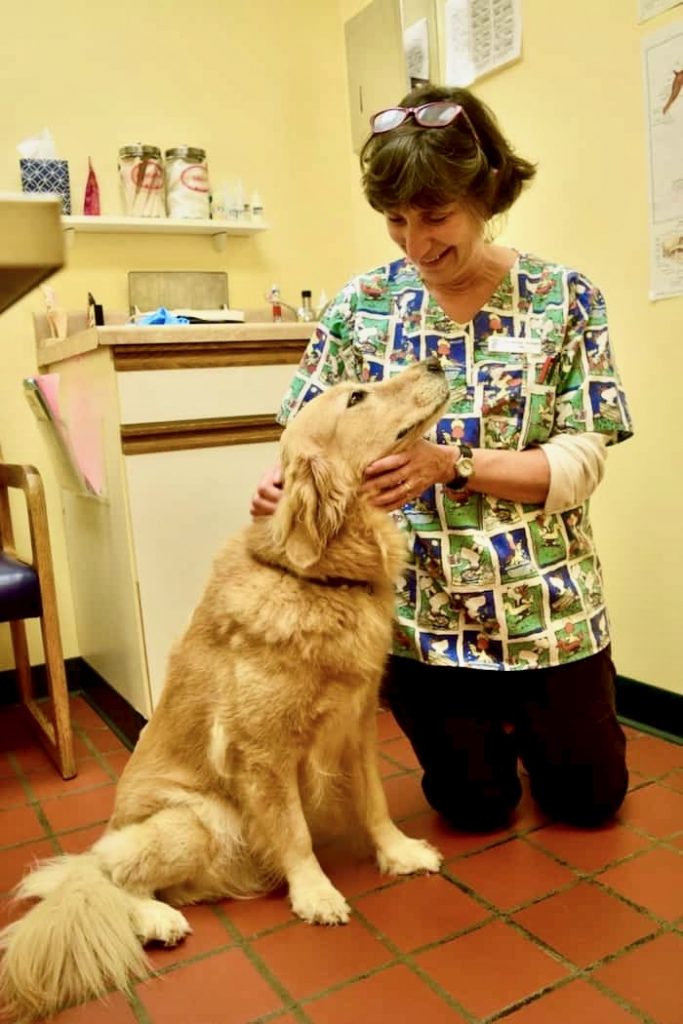
I relied on Honey’s vet to advise me about what medicine and first aid items I’d need to keep on board. She gave me the proper dosage for common human meds (like aspirin and Benadryl) that can be useful for dogs.
You’ll also want a good medical reference book for emergencies that happen far from vets. Where There Is No Pet Doctor: A Manual For Cruisers, RVer’s, And Backcountry Travelers (Amazon) was written especially for cruisers and other travelers. And Dr. Pitcairn’s Complete Guide to Natural Health for Dogs & Cats (Amazon) is a good general reference for holistic care along with a useful section on emergencies.
We spent a lot of time figuring out what vaccinations were most necessary for our cruising grounds.
If your vet isn’t located near a coastal city, she may not be an expert in the vaccinations your dog will need once they travel to other countries. But she’s certainly a good place to start.
Common requirements for dogs entering a new country include:
- Parvovirus, distemper, hepatitis, parainfluenza, kennel cough & bordetella (may be given in one vaccination)
- Coronavirus
- Rabies booster
- Titer test
- Microchipped
- Spayed or neutered
And speaking of traveling—if it’s your plan to actually cruise with your dog and not just live on a boat in one place, you’ll have a whole other set of considerations.
Want to learn more about managing boat dog medical care? Check out
Where There Is No Pet Doctor: A Manual For Cruisers, Rver’s, And Backcountry Travelers (Amazon) – for when you need to provide your own emergency care.
Getting Emergency Care When Traveling With Pets – most helpful for cruisers at marinas in the United States.
What You Should Know About Emergency Vets Before You Need One – a helpful reference for when you need an emergency vet in the United States.
Traveling with your dog
If you’re traveling with your dog, you’ll find plenty of people with opinions about how you do it. Some are official. And some are locals with a dog culture far different from the one you’re used to.
Legal requirements
Laws are easier to figure out.
Search on the country you wish to visit at Noonsite and click on “formalities” to find guidance about importing and exporting pets.
You can also search for specific countries and “import dogs” to get direct guidance about paperwork, vaccinations, and quarantines you’ll need to enter a country with your pup.
In fact, always end your research at the official government site for regulations. Things change quickly. And you need to go directly to the source to stay out of trouble.
But just completing legal steps isn’t the end.
For example, what is dog culture like in the place you’re visiting?
Local customs
In the Guna Yala, you might find families living on islands with dogs roaming free. Dogs that might not have received any shots.
So before taking your dog with you to visit the coconut harvesters on an island you’ve anchored off of, ask yourself if your pup would be safe meeting a dog with strong guarding tendencies. Or worse, with strong fecal worm tendencies.
If you’re traveling in Europe, you’ll have no problem visiting cities with your pup. In many places, public transportation is pet-friendly (although some require muzzles for large dogs). And outdoor dining (and sometimes indoor dining) is pet-friendly.
The United States is less pet-friendly than Europe, with only a small handful of cities that permit large dogs on public transit.
In Canada, many nominally dog-friendly restaurants require you to keep your dog off the patio you’re dining on. They may require you to tie him up to a nearby fence.
Wherever you plan to travel, take the time to research not only the legal requirements but the nature of dog life in that country before you make a choice that either puts your dog at risk or creates bad blood with the locals.
Oh, and I don’t have to tell you to always clean up after your pup, right? Yes, even if you’re in an area where dogs roam free.
You’re a visitor. You don’t want to behave in a way that keeps you from being invited back.
Want to learn more about traveling with your dog to other countries? Check out
Noonsite – a helpful resource for international cruisers.
PetTravel – a pet shipping company with lots of information regarding requirements for traveling with pets.
Pet Friendly Public Transportation in the US and Canada – getting around with pets via public transit in much of North America.
Sailing Offshore With a Dog – good information about Australia, the Solomon Islands, and Indonesia.
How to Sail with Dogs: 100 Tips for a Pet-Friendly Voyage (Amazon) – general guidance for cruising internationally dogs.
Final Thoughts About Living On A Boat With Your Dog
Ten thousand words later, does it sound like living on a boat with a dog is a lot of work?
If so, you’re right.
But let’s remember, just living on a boat is a lot more work than most people in developed countries ever have to do in their dirt homes. It’s also a lot more rewarding than living in a dirt home.
Having a dog on board will give you company and hours of fun. In many places, they will serve as an ambassador that helps you meet new friends. And they’ll give you an excuse to get off the damn boat and explore while others don’t bother boarding their dinghy unless they have to.
Is it more challenging to plan our route to take Honey off the boat regularly? Sure.
Does it take longer to dinghy to shore when we have to put on her mountaineering harness and swing the boom out to attack the block and tackle? Obviously.
And does it give us one more thing to worry about when storms are approaching? You betcha.
But Honey’s presence on our boat brings us joy, entertainment, and friendship. I wouldn’t trade her for anything.
If your dream is to live on a boat with your dog, I say go for it. And hopefully, your plan will be easier knowing what you need to think about first.

 4 Boat Dog Myths