

There are so many beautiful places to drop the hook along the Intracoastal Waterway (ICW). But how do you find dog-friendly anchorages on the ICW when you need them?
It isn’t always easy.
Iffy ICW Anchorages For Dogs
In four years cruising the ICW, I’ve generated a pretty good list of dog-friendly anchorages. But my best stories are about the “WTF-are-you-kidding-me” anchorages we’ve also found along the way.
There’s one close to North Carolina’s Alligator River Swing Bridge that we’ve never returned to.
We managed to slip our sailboat with the 5-foot draft into the area whose depths alternated between 4 feet 10 inches and 5 feet 2 inches (thank heavens for mud bottoms). But after feeling unsatisfied with the spot we chose, we weighed anchor.
It took a while. The anchor had snagged a shopping cart on the way up. But we eventually found a spot with better depths.
The recommended place to take the dog off was an abandoned boat ramp. After failing to find it, Mike circled the dinghy back to the boat to get better directions from me to help him find it.
He did. And luckily they did not find the snakes and alligators also common in that spot.

Or how about the fishing pier one cruiser recommended? We arrived at it to discover that we could barely reach the deck standing in our dinghy. And there was no way we could get ourselves and our 50-pound dog onto it.
I started to wonder. Did the cruiser who suggested it toss his chihuahua over the rails and wait for her to relieve herself and return to him while he stayed in the dinghy?
There’s gotta be a better way to find dog-friendly anchorages on the ICW.
Places To Take Your Dog Off
There’s no shortage of anchoring spots along the ICW. Although we’ve missed many of the spots regular cruisers love because there’s no nearby place to take the dog off.
And the slower you travel, the fewer options you’ll have in remote areas. One stretch of North Carolina causes us to struggle every year.
We’ve stayed at one expensive marina with a sexist dockmaster and cold water showers and another that barely deserves the name “marina” to avoid the Sloop Point Anchorage near Topsail Beach.
Sloop Point Anchorage takes some care to get in and out with a deep draft vessel. And once in, you’re surrounded by private property. The only place to take the dog off is to either take a long dinghy ride (about an hour each way for us) to the dog beach or to land at a small kayak launch.
We complain about it every time. But without a faster vessel or a dog willing to potty on board, we have yet to find a better option.
But that’s not typical.
We’ve had good luck up and down the ICW finding anchorages near typical spots that work for walking a dog. Keep your eyes open for the following places to take your dog off and plan to anchor nearby.
I’ll start by sharing those that might cost you some money before naming our favorite free spots to land with the dog when you drop the hook.
Marinas
Is there any easier place to take a dog off than at a marina?
We’ve found a range of experiences taking Honey off at marinas. Some are almost hostile to cruisers who choose to anchor. Others charge a small fee to land your dinghy. And others welcome anyone.
How do you know which is which? Some cruising guides will have notes about whether a marina allows cruisers to land their dinghies. But the easiest way is to just ask.
In four years, we’ve only found two marinas totally unwilling to allow cruisers to land their dinghy with a dog. And in truth, neither of them were near particularly nice anchoring spots.
We didn’t mind striking the nearby anchorages off our list.
Fuel docks
If you find a fuel dock close to where you plan to anchor for the day, you may be able to take your dog off before dropping the hook.
On a quiet day, some fuel docks will allow you to stay long enough after fueling to take your dog for a brief comfort break. But I wouldn’t bother to ask on a busy holiday weekend. Choose your moment.
And remember that the staff at the dock may be more willing to accommodate you if you’re in a large powerboat that buys fuel hundreds (or more) dollars at a time. In our sailboat that sips fuel and that we fill with 35 gallons of diesel, I’m not going to ask for special favors unless things are really dead.
Dock and Dine Restaurants
Why not take your dog out to dinner?
Many restaurants with outdoor seating along the ICW are dog-friendly. Check with the hostess and you can probably take your dog for a quick stroll before enjoying cocktails on the deck or dinner.
When we anchor in Carolina Beach, North Carolina we switch things up by taking Honey off at the town dinghy dock or by landing at one of the pet-friendly restaurants.
Of course, dining out isn’t always in our budget. So we usually look for anchorages close to some of these free options.
Boat Ramps
Boat ramps run the gamut from developed sites with restrooms and a floating dock for tying your dinghy off to muddy parking lots in the middle of critter-infested swamps.
But they’re plentiful. If you can’t find any other place to take your dog off near an anchorage, you can probably find a boat ramp. In fact, many new highway bridges have ramps, built during the construction.
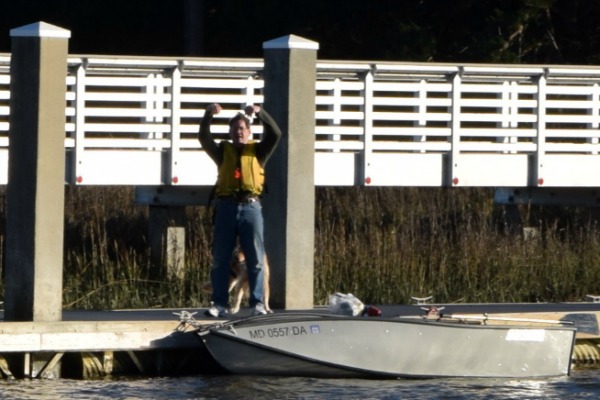
How do you know if there’s a boat ramp near an ICW anchorage you’re considering?
Check out the state’s listings:
- Virginia Boat Ramp Locations – search by a body of water or county. Listings have GPS coordinates and links to a map.
- North Carolina Boat Ramp Locations – search by a map. Listings include hazards to look out for and a picture of the ramp.
- South Carolina Boat Ramp Locations– search by name of a body of water or map. Listings have GPS coordinates and a picture.
- Georgia Boat Ramp Locations – click on “boat” in the left sidebar and click the type of ramps to get a map. You can also add a helpful NOAA chart overlay.
- Florida Boat Ramp Locations – click on the map to get a description of ramps and the ability to zoom in to satellite view.
Of course, there are more fun places to take your dog off along the ICW. And if you anchor near one of these, you’ll enjoy your travels even more.
Parks & Recreational Areas
Our favorite anchorages are close to state parks and recreational areas.
Buck Hall Recreation Area just south of McClellanville, South Carolina gives you a nice chance to stretch your legs after a long travel day. And it makes the nearby Awendaw Creek a perfect anchorage—with good holding and the perfect location for timing your transit of the skinny waters crossing Jeremy Creek in McClellanville when going North.
Also in South Carolina, you’ll find the beautiful Edisto Island State Park—worth the several mile trip off the ICW with a floating dinghy dock, a nature center, and 24-hour restrooms near the boat ramp.
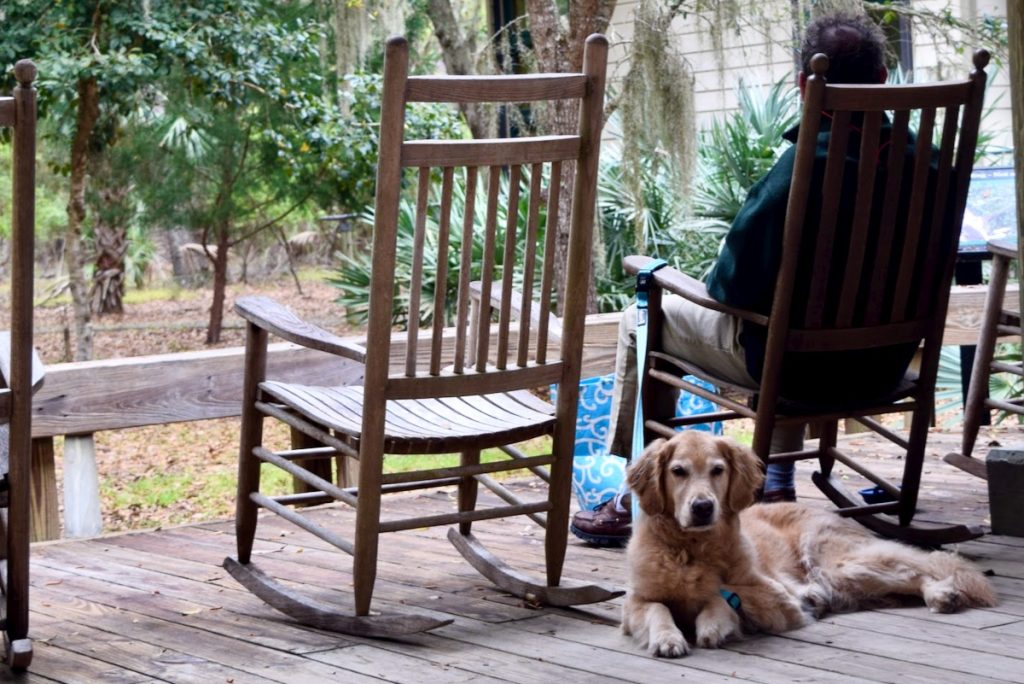
You can search for state parks near your travel routes on individual state park websites. Or find all kinds of pet-friendly places to stop (restaurants, parks, and more) at GoPetFriendly.com (Full disclosure – I work as a Virtual Assistant for this site. But long before that I was a frequent user.)
Beaches
Depending on where along the ICW you are, the chance is good that the river you’re anchored in feeds directly to the ocean. It may not be navigable for your main vessel. But it is probably fine for your dinghy—check your charts.
And that’s where you’ll find some splendid beaches.
Some of our favorite ICW anchorages are within sight of a beach.

Heads-up: If you’re traveling on a hot, sunny weekend, anchorages located near beautiful beaches will be packed with locals. Try to time your arrival at your favorite beach anchorages for mid-week.
Community day docks
Many towns have day docks to allow locals and cruisers to visit restaurants and shops by boat. Cruising guides will often point these out for you.
We’ve docked Meander at the Georgetown, South Carolina town dock several times. We get off just long enough to walk Honey before anchoring in the Sampit River. It makes for an easy arrival.
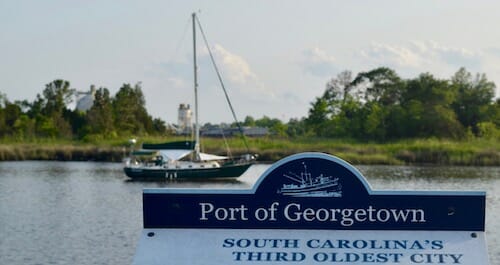
If you follow our example, don’t overstay your welcome. Although every community dock we’ve visited specifies no overnight docking, there’s always someone who disregards the rules.
We’ve even met some of the harbormasters looking for the scofflaws as we pull away in our dinghy.
It would be awful if towns stopped offering these amenities because of rude cruisers. Don’t be one.
Finally, I come to the last place we’ve found to take Honey off the boat from an anchorage. And you can’t plan for them. They’re just cruiser magic.
Private homes
It doesn’t happen often but occasionally we’ll anchor in a residential area where a dog-loving homeowner will invite us to bring Honey ashore at their private dock.
It pays to smile and wave at locals when you anchor in their neighborhood and answer their questions cheerfully.
Oh, and it doesn’t hurt to have your cute dog sitting on the deck looking plaintive.
So how do you generate your list of dog-friendly anchorages for your ICW trip?
Finding Dog-Friendly Anchorages On The ICW
As we discover new anchorages with good places to take Honey off the boat, I add them to a spreadsheet organized by the ICW mile marker.
But we found our favorites using a variety of sources.
Cruising guides
Yeah, I know you can find darn near anything online. But I like having a paper cruising guide.
Our favorite, Mark and Diana Doyle’s On the Water Chart Guides are no longer being updated. But if you find an old one in a cruiser’s library, pick it up. It’s worth it to read about the history and animal life along the ICW.
Just double-check any anchorage suggestions.
Links below may be affiliate links. As an Amazon Associate, I earn from qualifying purchases.
Waterway Guides is continuing to update Skipper Bob Anchorages Along the Intracoastal Waterway. There isn’t as much detail as I would like. But it will give you a start in finding dog-friendly anchorages.
Just look for the little dog symbol.
Online, crowdsourced information
While you need to use good judgment when getting advice from strangers, you can find up-to-date information online. Active Captain provides crowdsourced information that comes with Garmin charts. We also use the overlay with Aqua Map on our iPad.
Cruiser’s Net has been around for a long time. And looks it. But it is still a good source of info for ICW cruisers.
If you find yourself stuck for an anchoring spot, Facebook is a good source of information from other current and past cruisers.
Women may ask to join a subgroup of Women Who Sail for the ICW, Florida, and the Bahamas.
And ICW Cruising Guide by Bob 423 is the private Facebook group that supports Bob Sherer’s ICW Cruising Guide. (I don’t yet own this so I can’t talk about it specifically. But it will be the next guide I buy.)
The Facebook group is an excellent source of up-to-date information about the ICW.
Other cruisers with dogs
Cruisers with pups can help each other.
I’ve turned up at one of our regular anchorages to find two Ranger Tugs captained by cruisers I swapped anchorages with by radio.

But to get the best information, consider who you’re getting a recommendation from.
For example, I’ve approached recommended anchorages to find that at all but the highest tides, the beach was covered with a sharp oyster reef. A cruiser wearing shoes might be able to carry a wee pup above the low tide line to safer ground. But there was no way to land our 50-pound golden retriever safely.
And a cruiser whose dinghy has a 15 HP engine can travel a farther distance more quickly than we can with our folding dinghy and 6 HP engine. So an anchorage a long distance from a landing spot won’t work for us.
We land a short distance away from where we anchor.
Here’s one cruiser’s suggestion for dog-friendly anchorages. Check out my Travel Though 2018 with Meander to see some of my favorite anchorages with GPS coordinates.
Because besides relying on information shared by others, I also do my own research on the water.
Look for them underway
While traveling, I’m always on the lookout for anchorages and places to take Honey off.
I keep a sharp watch for waterfront restaurants, boat ramps, town docks, and more. I use my binoculars to get a good look. Then I look for nearby oxbows or rivers that might be a good anchoring spot.
I take good notes. Note GPS coordinates. And in my next spare minute, compare the chart to my notes.
If everything looks good, I add it as a potential anchorage in my spreadsheet.
Making A Daily Plan
Some folks cruising the ICW for the first time try to wing it. It’s a fine plan if you’re looking for inspiration for boating horror stories to tell at your next cocktail hour.
Even after several times transiting the ICW, we still plan our days in advance.

Now we have the benefit of reviewing our log book to see our notes about hazards and anchorages. But our first year, here’s how we created a plan each day.
- Guesstimate how far we’d be likely to travel in a day given the cruising speed of our vessel.
- Use our chart or cruising guide to pick a likely stopping point for the night.
- Review the sources I recommended above to find likely spots to take the dog off the boat near potential anchorages.
- Choose one stopping point for the night with a backup in case our first option doesn’t work out (wind from the wrong direction, too crowded, etc.)
- Go back to review the route for hazards, bridges, etc. that may affect our travels.
Here’s an important note: don’t overestimate how fast you can travel in a day. You will still need to get routine boat chores done after dropping the hook (walking the dog, making dinner, cleaning up the cabin, checking weather, reviewing our route, and, in our case, working for clients etc.)
And the planning process involved in finding dog-friendly anchorages to stop each night on the ICW adds a level of complexity.
As sailors, we know we can’t travel quickly. But even power boaters overestimate how far they can travel after accounting for no-wake zones, slow passes in canals, and bridge openings.
Your travel will be be far less tiring and more enjoyable if you build in some padding to your schedule, leaving time to relax.
Making The Most Of Dog-Friendly Anchorages On The ICW
I have one final tip for finding dog-friendly anchorages on the ICW. And that’s to not be afraid to get off the ICW.
We’ve found some amazing anchorages traveling just a short distance off the ICW—like off the shores of Edisto Island State Park. And we’ve enjoyed Charleston for weeks at a time off the shores of Brittlebank Park up the Ashley River where few cruisers ever go.
The town of Washington, North Carolina, a day’s sail up the Pamlico River, was one of our favorite discoveries.
![Finding Dog-Friendly Anchorages - like Washington, NC. [golden retriever lying down beside a blue crab sculpture.]](https://www.somethingwagging.com/wp-content/uploads/2018/06/Honey-w-crab.jpg)
Sure, you might be traveling the ICW to get somewhere. But if you were only interested in arriving at a destination, you could drive. Or take a plane.
I’m assuming that by setting off with your dog on a boat, you’re up for an adventure. So why not make the most of it?
Find those awesome dog-friendly anchorages. And get off the damn boat.
Your Turn: What are your favorite dog-friendly anchorages on the ICW? Share it in the comments below.
Don’t miss out on the hacks, tips, & encouragement that will help cruise happily with your dog. Join today and I’ll also send you my Checklist to Keep Dog Hair From Wrecking Havoc On Your Boat.
Subscribe today!
 Love Living On A Boat With Your Dog – The Ultimate Guide